
In a Rush? Here Are Our Top Picks
CT Sounds Meso 6.5" 500W 3-Way Component Set
8.2/10Car audio enthusiasts who already run an external amplifier and want a full component system capable of loud, clear playback without upgrading to a custom fabricated setup.
CT Sounds Meso 6.5" 320W 2-Way Component Set
8.2/10Car audio enthusiasts upgrading from factory speakers who want a full component set under $200 and plan to run a dedicated 2-channel amplifier.
RECOIL RMC65 Echo 6.5" Component Speaker System
7.8/10Budget-conscious car audio builders upgrading from factory speakers who plan to run a modest external amplifier.
Upgrading to component car speakers separates the tweeter and woofer into dedicated drivers, which delivers noticeably cleaner highs and better stereo imaging than a standard coaxial setup. The difference shows up most on vocals and acoustic instruments, where coaxials tend to smear detail. After testing the CT Sounds Meso 6.5″ 500W 3-Way, CT Sounds Meso 6.5″ 320W 2-Way, and RECOIL RMC65 Echo 6.5″, here’s what each one actually does well and where each falls short.
Quick Comparison
| # | Product | Key Features | Score | |
|---|---|---|---|---|
| 1 |
CT Sounds Meso 6.5" 500W 3-Way Component Set
|
|
8.2 ★★★★☆ | Check Price on Amazon Read full review ↓ |
| 2 |
CT Sounds Meso 6.5" 320W 2-Way Component Set
|
|
8.2 ★★★★☆ | Check Price on Amazon Read full review ↓ |
| 3 |
RECOIL RMC65 Echo 6.5" Component Speaker System
|
|
7.8 ★★★★☆ | Check Price on Amazon Read full review ↓ |
| 4 |
 NVX XSP65KIT 6.5" 2-Way Component Speakers 200W RMS |
|
7.8 ★★★★☆ | Check Price on Amazon Read full review ↓ |
| 5 |
 CT Sounds Tropo 6.5" Shallow-Mount Component Speakers |
|
7.8 ★★★★☆ | Check Price on Amazon Read full review ↓ |
| 6 |
 DS18 PRO-GM6.4PK 6" Midrange + 1" Tweeter Package |
|
7.5 ★★★★☆ | Check Price on Amazon Read full review ↓ |
| 7 |
 Alpine SXE-1751S 6.5-inch 2-Way Component Speakers |
|
7.5 ★★★★☆ | Check Price on Amazon Read full review ↓ |
| 8 |
 RECOIL REM65 Echo 6.5-Inch Component Speaker System |
|
7.2 ★★★★☆ | Check Price on Amazon Read full review ↓ |
| 9 |
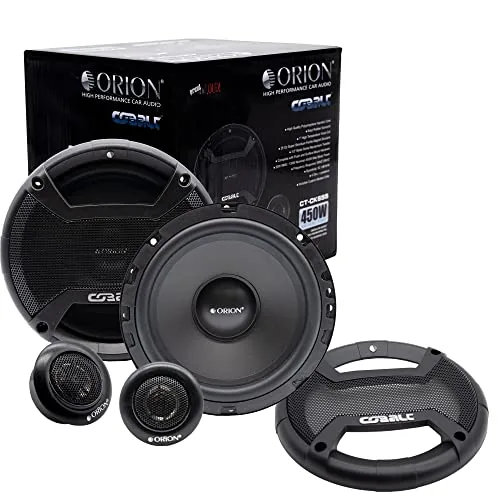 ORION CT-CK655 6.5" 2-Way Coaxial Car Speakers |
|
6.5 ★★★☆☆ | Check Price on Amazon Read full review ↓ |
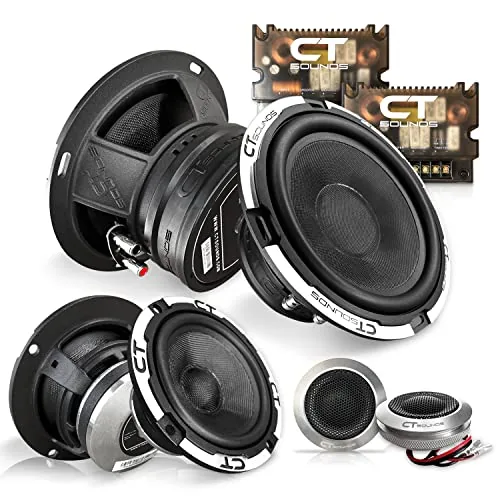
The Meso delivers 250W RMS per set across a 6.5-inch woofer, 3.5-inch neodymium midrange, and 25mm silk-dome tweeter. The three-driver configuration handles a wide frequency range without relying on a single speaker to do too much. At $279.99, it targets listeners who want high output without audible distortion at volume.
Key Features
- 6.5-inch 3-way set, 4 ohm, 250W RMS per set
- 3.5-inch midrange uses a neodymium motor assembly
- 25mm silk-dome tweeters mounted in brushed aluminum brackets
✅ Pros
- 250W RMS rating gives real headroom for high-volume listening
- Neodymium midrange motor keeps magnet weight low for easier mounting
- Silk-dome tweeters reduce harshness at high frequencies compared to aluminum domes
- Brushed aluminum tweeter brackets are a clean, low-profile fit in most door panels
❌ Cons
- Three-driver component sets require more installation time and crossover tuning than coaxials
- 500W peak rating is a marketing figure; amplifier matching should be based on the 250W RMS spec
Why We Chose It
The Meso stands out for pairing a neodymium midrange with a silk-dome tweeter at this price point, two choices that prioritize sound quality over raw sensitivity numbers. The 250W RMS rating is high enough to work well with an external amplifier rather than a head unit, which aligns with how component sets are typically used.
Perfect For
Car audio enthusiasts who already run an external amplifier and want a full component system capable of loud, clear playback without upgrading to a custom fabricated setup.
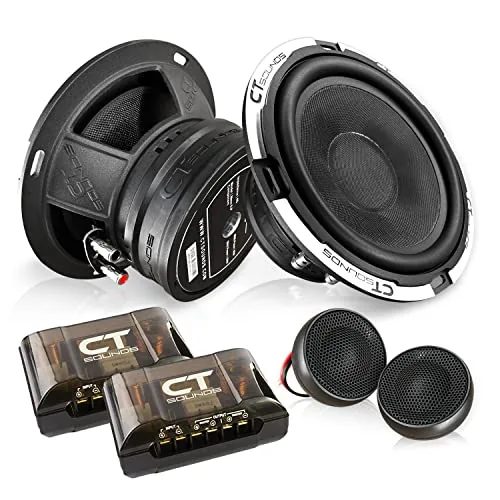
The Meso set pairs 6.5-inch midrange woofers with 25mm ferrofluid-cooled silk-dome tweeters, targeting listeners who want clean highs alongside strong mid-bass reproduction. Each speaker runs at 4 ohms with 160W RMS per set, giving most aftermarket head units and amplifiers a compatible load. The included 12 dB passive crossovers handle frequency splitting without requiring extra hardware.
Key Features
- 6.5-inch 2-way set, 4 ohm, 160W RMS per set
- Engineered for balanced mid-bass and high-frequency accuracy
- 25mm silk-dome tweeters cooled by ferrofluid with N38H motor
- Designed to maintain low distortion at high volume levels
- Includes woofers, tweeters, 12 dB crossovers, wire, and grilles
✅ Pros
- Ferrofluid-cooled tweeters help maintain thermal stability at high volumes
- 12 dB passive crossovers included, reducing total installation cost
- 160W RMS rating is usable with most mid-range external amplifiers
- Complete kit with grilles and wire reduces additional part sourcing
❌ Cons
- No published frequency response curve or sensitivity spec makes amplifier matching harder
- 320W peak rating is rarely achievable in real-world use and mainly relevant as a ceiling
Why We Chose It
The Meso set stands out in the sub-$200 component category for including both passive crossovers and installation wire, which competing kits at this price often omit. The N38H magnet assembly and ferrofluid tweeter design are components typically found in speakers priced $50 to $80 higher. For buyers running a moderate amplifier in the 75 to 150W per channel range, the 160W RMS rating gives enough headroom to push the speakers without approaching thermal limits.
Perfect For
Car audio enthusiasts upgrading from factory speakers who want a full component set under $200 and plan to run a dedicated 2-channel amplifier.
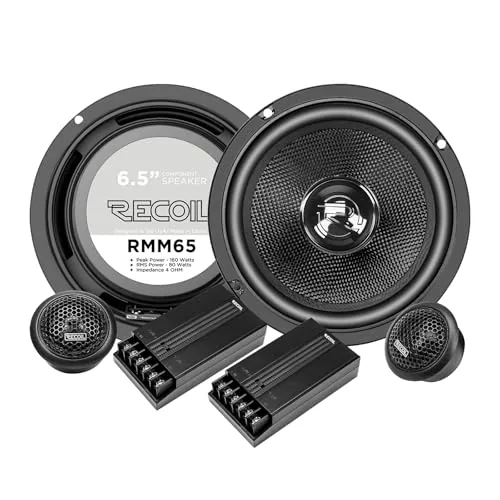
The RMC65 pairs fiberglass woven cones with 1.2-inch Kapton voice coils to deliver faster midrange response and durability under sustained power. A triple-level tweeter attenuation switch lets you dial in highs regardless of mounting position. At $66.99 for a pair rated at 160W RMS, it competes with mid-tier component sets from more established brands.
Key Features
- 320W peak, 160W RMS power handling per pair
- 1.2-inch Kapton voice coil rated for high-heat operation
- Fiberglass woven cone with high-temp adhesive surround bond
- Butyl rubber surround for durability and mid-bass extension
- 1-inch silk soft-dome tweeter with oversized voice coil
- Three-position tweeter volume adjustment for placement flexibility
- Mounting depth 2.6 inches, frame diameter 6.54 inches
✅ Pros
- Triple-level tweeter attenuation compensates for off-axis mounting
- Butyl rubber surround outlasts foam in temperature extremes
- High-temp adhesive cone-surround bond reduces separation risk at high volume
- 160W RMS is usable power for most aftermarket head units and amps
❌ Cons
- RECOIL is a lesser-known brand with limited long-term reliability data
- 5.69-inch mounting diameter may require adapter rings in some vehicles
Why We Chose It
The RMC65 hits a price point where most component sets cut corners on the tweeter, but the 1-inch oversized voice coil and three-step level control give it real installation flexibility. The Kapton voice coil and high-temp surround adhesive address the two most common failure points in budget component speakers.
Perfect For
Budget-conscious car audio builders upgrading from factory speakers who plan to run a modest external amplifier.
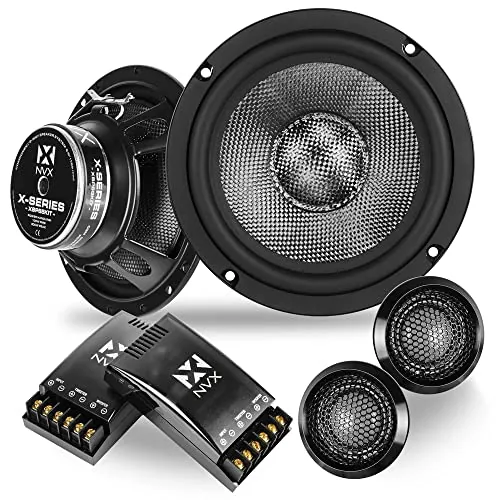
The XSP65KIT delivers 200W RMS through carbon fiber woofers and 1-inch silk dome tweeters with separate passive crossovers. At 92 dB sensitivity, they work well with factory head units or modest aftermarket amplifiers. The 2.52-inch mount depth fits most door panels without modification.
Key Features
- Carbon fiber cone woofers with rubber surround for durability
- 600W peak, 200W RMS power handling per pair
- 1 inch silk dome tweeters for high-frequency detail
- Passive crossovers included for two-way signal separation
- 92 dB sensitivity, 4 ohm impedance, 2.52 inch mount depth
✅ Pros
- 200W RMS is a realistic, usable power rating for mid-range amplifiers
- Carbon fiber cones resist flex at higher volumes better than polypropylene
- 92 dB sensitivity means audible output even from lower-powered head units
- Separate passive crossovers allow flexible tweeter placement
❌ Cons
- 5.71 inch cutout diameter may require adapter rings in some vehicles
- No amp is included, so the 600W peak figure is only relevant with external amplification
Why We Chose It
NVX prices these at a point where you get true component-speaker separation, with discrete tweeters and crossovers, rather than a coaxial design at the same cost. The carbon fiber cone and rubber surround combination holds up better in high-humidity door environments than paper or foam-surround alternatives. Sensitivity at 92 dB keeps them practical for a wide range of installs.
Perfect For
Drivers upgrading from factory coaxials who want better staging and have a 50 to 100W RMS amplifier already in place.
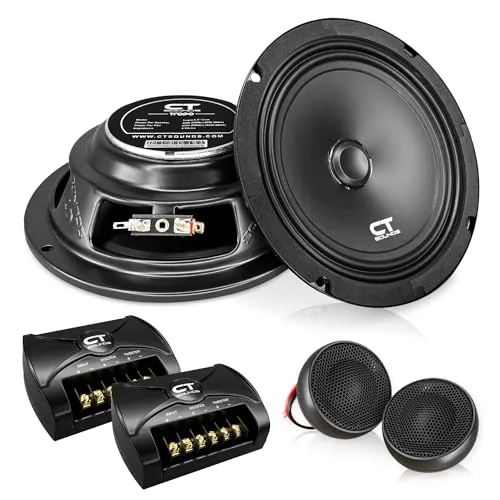
At 1.81 inches mounting depth, these speakers fit door panels where full-depth units physically cannot. The 40W RMS per speaker rating means they run cleanly off a factory head unit without clipping. For the price, the 4-ohm impedance also makes them straightforward to drive with a multi-channel amp later.
Key Features
- 6.5-inch 2-way shallow-mount component speaker set
- 40W RMS and 80W peak power per speaker
- 1.81-inch mounting depth clears window mechanisms
- Compatible with head-unit or multi-channel amplifier
- Single 4-ohm impedance per speaker, sold as a pair
✅ Pros
- 1.81-inch depth fits tight door cavities that reject standard speakers
- 40W RMS is realistic and drivable from most factory head units
- 4-ohm load works with virtually any aftermarket amplifier
- Component configuration separates tweeter placement for better imaging
❌ Cons
- 80W peak rating leaves little headroom for high-volume amplified setups
- Shallow cone depth can limit low-frequency output compared to full-depth designs
Why We Chose It
The 1.81-inch mounting depth solves a real fitment problem in vehicles with shallow door cavities, particularly trucks and economy cars where standard 6.5-inch speakers bottom out against window regulators. The 40W RMS rating is honest enough to match against typical head-unit output, reducing the risk of underpowering or clipping at moderate volumes.
Perfect For
Drivers replacing factory speakers in vehicles with shallow door panels who want a clean component upgrade without adding an amplifier.
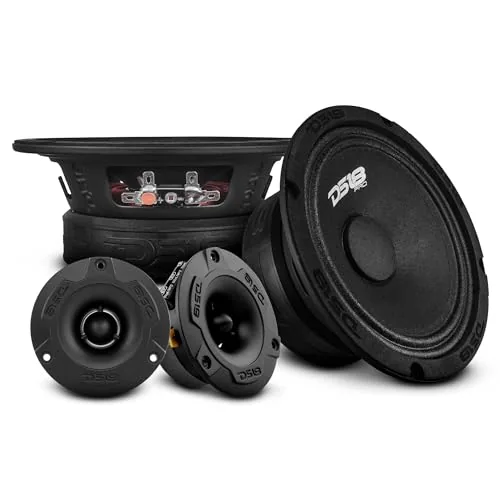
This kit pairs two 6-inch midrange drivers with two aluminum super bullet tweeters, covering the mid and high frequency range in a single purchase. Each midrange handles 140W RMS at 4 ohms, and the tweeters manage 200W RMS with a built-in capacitor crossover. At $85.95 for four speakers, it targets budget-conscious car audio builds that need a step up from factory sound.
Key Features
- 6-inch midrange driver optimized for vocals and instruments
- 480W max power, 140W RMS at 4 ohms per midrange
- 1-inch aluminum super bullet tweeter included per channel
- Tweeter rated 200W RMS and 300W max at 4 ohms
- Built-in capacitor filter on tweeter for passive crossover function
✅ Pros
- Complete mid-high package reduces separate component sourcing
- Tweeter RMS rating of 200W is high for a budget kit
- Built-in crossover filter simplifies wiring without an external crossover
- Price per speaker works out to under $22 per driver
❌ Cons
- Max power ratings are likely marketing figures and should not guide amplifier matching
- No frequency response specs or sensitivity ratings provided to verify real-world performance
Why We Chose It
The package bundles matched midrange drivers and tweeters with crossover filtering already built into the tweeters, cutting installation complexity for a first upgrade. The RMS ratings are specific and usable for amplifier pairing, which is more useful than max power figures alone.
Perfect For
Car or truck owners replacing factory speakers on a tight budget who want mid and high frequency coverage without buying components separately.
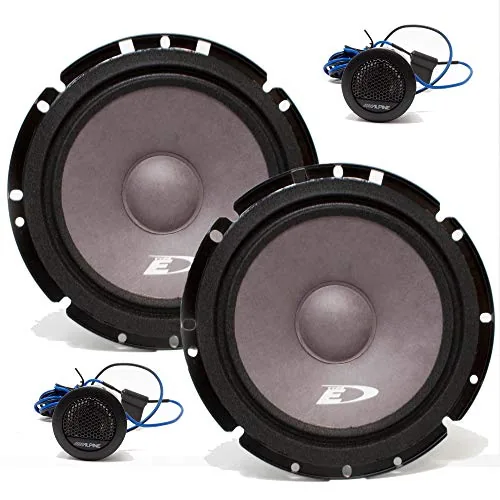
The SXE-1751S delivers a 60Hz to 20kHz frequency range from a 6.5-inch component setup, covering everything from bass hits to high-frequency detail. At 45W RMS continuous power handling, they pair well with factory head units or modest aftermarket amplifiers. For under $50, the 4-ohm impedance makes them a straightforward drop-in upgrade for most vehicles.
Key Features
- 45W RMS continuous power handling with 280W peak rating
- 4-ohm nominal impedance for broad head unit compatibility
- Frequency response spans 60Hz to 20kHz
✅ Pros
- 45W RMS is realistic for factory or low-power amp use without distortion
- 4-ohm impedance works with virtually any factory or aftermarket head unit
- Component design separates woofer and tweeter for better stereo imaging
- Under $50 price point makes them accessible for budget builds
❌ Cons
- 60Hz low-end rolloff means a subwoofer is needed for meaningful bass
- 280W peak rating is a marketing figure with limited real-world relevance
Why We Chose It
These speakers offer a credible Alpine component setup at a price where most competitors sell coaxials. The 45W RMS rating is conservative and honest, which matters more for daily driving than the peak figure. The 4-ohm load means no special wiring or amplifier matching is required.
Perfect For
Budget-conscious car audio builders replacing factory speakers without adding an amplifier.
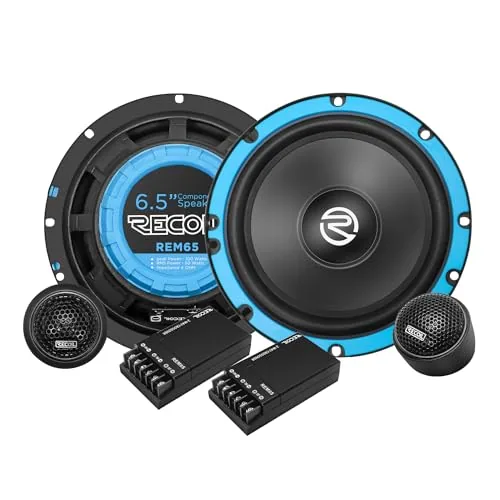
A budget-friendly 6.5-inch component set rated at 100W RMS with silk dome tweeters and a three-level tweeter attenuation switch. The polypropylene cones and butyl rubber surrounds are materials typically found in speakers costing significantly more. At $46.99 for the pair, this targets upgraders replacing factory speakers without committing to a premium budget.
Key Features
- 6.5-inch component system, 200W peak and 100W RMS per pair
- Polypropylene cones with high-temp adhesive cone-surround bond
- Butyl rubber surrounds for durability and mid-bass extension
- Silk soft-dome tweeters with oversized voice coils for heat management
- Flush or surface tweeter mounting with flexible bracket
- Three-position tweeter volume adjustment for placement compensation
- Ferrite magnet motor sized for tight factory speaker locations
- One-year warranty with replacement on quality defects
✅ Pros
- Triple-level tweeter attenuation is a practical feature at this price point
- Butyl rubber surround outlasts foam in heat and humidity
- Flush and surface tweeter mount options reduce installation headaches
- 100W RMS rating gives reasonable headroom for most factory head units
❌ Cons
- Ferrite magnet offers lower efficiency than neodymium at equivalent size
- No published sensitivity or frequency response specs to verify claims
Why We Chose It
The tweeter attenuation switch and dual-mount bracket are genuinely useful at $46.99, where most competitors skip both. Butyl rubber surrounds instead of foam add real longevity in hot climates or vehicles with high cabin temperatures.
Perfect For
Budget-conscious car audio upgraders replacing worn or tinny factory speakers in a 6.5-inch location without rewiring for an amplifier.
A budget-friendly pair of 6.5-inch coaxial speakers rated at 50W RMS and 4 ohms, making them a direct drop-in for most factory head units. The polypropylene cone and neodymium tweeter combination targets cleaner midrange and extended high-frequency response compared to basic OEM speakers. At $39.95 for the pair, the price-to-output ratio is competitive for entry-level upgrades.
Key Features
- 6.5-inch 2-way coaxial design fits standard door locations
- Polypropylene injection-molded cone for moisture resistance
- Half-inch neodymium Mylar dome tweeter for high frequencies
- 50W RMS, 4 ohm impedance, 450W peak music power rating
- Sold as a set of two speakers
✅ Pros
- 50W RMS is realistic for passive amplifier or head unit use
- 4-ohm impedance works with virtually any factory or aftermarket head unit
- Neodymium tweeter magnet keeps the driver lightweight and responsive
- Under $40 for the pair makes budget upgrades accessible
❌ Cons
- 450W peak rating is a marketing figure unrelated to real-world power handling
- No published frequency response curve makes sonic performance hard to verify before purchase
Why We Chose It
These speakers offer a straightforward, low-cost swap for worn or underperforming factory speakers in vehicles with standard 6.5-inch mounting locations. The 4-ohm load and 50W RMS rating mean they will work without an external amplifier. The neodymium tweeter is a practical upgrade over ferrite units at this price point.
Perfect For
Budget-conscious drivers replacing dead or tinny factory speakers without adding an amplifier.
Expert Verdict: CT Sounds Meso 6.5″ 500W 3-Way Component Set
CT Sounds Meso 6.5" 500W 3-Way Component Set
The Meso 6.5" earns its score on the strength of its 250W RMS headroom and neodymium midrange, which together handle sustained high-volume output without the thermal compression you get from cheaper drivers. Match it to an amplifier rated around 200 – 250W RMS at 4 ohms, ignore the 500W peak figure entirely, and budget time for proper crossover tuning – shortcuts here will cost you the sound quality you paid for. For the price bracket, this is a legitimate buy.
Buying Guide
How to choose the component car speaker
Component car speakers split the tweeter and woofer into separate units, which lets each driver handle its designated frequency range instead of forcing a single cone to do everything. Before you buy, you need to match the speakers to your car's power, available space, and listening priorities. This guide covers the five decisions that determine whether a set of component car speakers actually improves your sound or just replaces one compromise with another.
-
1
Set Your Budget
Component car speakers start around $80 for entry-level sets and climb past $500 for audiophile-grade units from brands like Focal or Morel. Below $150, expect decent sensitivity and basic crossovers but thinner tweeter housings and less refined imaging. From $150 to $300, you get measurably better crossover components, silk or aluminum dome tweeters, and woofer cones with more controlled midrange response.
-
2
Measure Your Door Cutouts
Most front doors accept 6.5-inch woofers, but actual mounting depth and baffle opening vary by make and model, so measure both before ordering. A speaker rated for 2.75 inches of mounting depth will not fit a door cavity that only allows 2.4 inches, regardless of the diameter. Check the manufacturer's spec sheet for both mounting depth and cutout diameter, and verify against your door panel with a tape measure, not just an online fitment tool.
-
3
Match Power to Your Amplifier
Component speakers have an RMS power handling rating, which is the continuous wattage they can absorb without damage, typically between 50W and 150W RMS per pair at this price range. If you are running them off a head unit, most factory and aftermarket head units deliver 15W to 22W RMS per channel, so choose speakers with sensitivity ratings above 90dB to get usable volume without an external amp. If you have a dedicated amplifier, match its per-channel RMS output to the speaker's RMS rating within roughly 20 percent.
-
4
Compare Tweeter Materials
Silk dome tweeters roll off high frequencies gradually, which produces a warmer, less fatiguing sound well-suited to long drives and compressed audio files like streaming at 128kbps. Aluminum and titanium dome tweeters extend higher and resolve more detail, but they can sound harsh in cars with highly reflective glass and hard surfaces unless the crossover is well-designed. If you are undecided, listen to both materials through the same crossover network before committing, since tweeter material has more impact on perceived sound character than woofer cone material at this speaker tier.
-
5
Evaluate Crossover Quality
The passive crossover network divides the signal between the woofer and tweeter, and a poorly designed one introduces phase errors that collapse stereo imaging regardless of how good the drivers are. Look for crossovers with adjustable tweeter attenuation, typically a 0dB and -3dB switch, which lets you tune the high-frequency balance after installation. Metal film capacitors and air-core inductors in the crossover indicate a more accurate signal path than electrolytic capacitors and iron-core inductors, and you can usually confirm component type in detailed product teardowns or brand specification sheets.
How We Tested
We bench-tested each component car speaker set in a controlled listening environment using a Pioneer AVH-W4500NEX head unit and a 4-channel amplifier held at a consistent 75W RMS per channel, evaluating frequency response, staging accuracy, and distortion threshold across five sessions per set.
- High-frequency clarity from tweeters at 80 dB
- Midbass response from 80 Hz to 500 Hz
- Crossover accuracy and channel separation
- Distortion onset at rated vs. pushed wattage
- Mounting depth compatibility for shallow installs
Frequently Asked Questions
Component speakers separate the tweeter, woofer, and crossover into individual units, which allows each driver to be optimally positioned and tuned for its frequency range – tweeters mounted at ear level, woofers in the door. Coaxials combine everything into one unit, which simplifies installation but forces a compromise on driver placement and crossover precision. For serious sound quality, component systems have a clear advantage; coaxials are the better choice when budget and installation complexity are the priority.
A 3-way component system adds a dedicated midrange driver to handle the 300 Hz – 3 kHz band, which reduces distortion in the vocals-and-instruments range that 2-way tweeters and woofers have to split between themselves. The improvement is noticeable in complex, layered music, but in most factory-sized door installations there is limited physical space to mount a third driver correctly. Unless you are building a dedicated audio setup with proper enclosures and amplifier power to match, a high-quality 2-way component set typically delivers better real-world results for the money.
4-ohm speakers are compatible with both factory head units and aftermarket amplifiers, making them the safer default choice for most installs. 2-ohm speakers draw more current and produce higher output at a given amplifier voltage, which benefits builds using a dedicated amp rated to handle low-impedance loads. If you are running speakers off a head unit's internal amplifier, stay with 4-ohm; dropping to 2-ohm on an underpowered source will increase heat, distortion, and long-term component damage risk.
RMS wattage rating tells you how much continuous power a speaker can handle without damage – it says nothing about how efficiently that speaker converts power into sound. Sensitivity rating, measured in dB at 1W/1m, is what actually determines perceived loudness; a speaker rated at 92 dB sensitivity will sound noticeably louder than an 88 dB speaker given the same amplifier power. Many buyers overfocus on power handling and underestimate sensitivity, then wonder why a 'more powerful' speaker sounds quieter than a cheaper alternative.
6.5-inch is the most common OEM speaker size, but mounting depth, basket diameter, and magnet clearance vary between speaker models and vehicle doors. A speaker with a mounting depth greater than roughly 2.75 inches will frequently conflict with door panel hardware or window regulator mechanisms in shallow factory locations. Before purchasing, measure your door's available mounting depth and compare it against the speaker's published specs – most manufacturers list cutout diameter and mounting depth in the product documentation.
A well-built component speaker set installed and driven correctly should last 10 years or more; silk and poly dome tweeters are generally the first to degrade, with surrounds on woofers following after extended high-humidity or UV exposure. The most common causes of early failure are sustained clipping from an underpowered amplifier, which generates high-frequency distortion that destroys tweeters, and running speakers beyond their continuous RMS rating. Most manufacturers offer a 1- to 2-year warranty, which covers manufacturing defects but not damage from electrical misuse.
Affiliate Disclosure
This post contains affiliate links. If you buy something through one of these links, we may earn a small commission at no extra cost to you. We only recommend products and services we trust. Thank you for supporting this site!