
Finding a reliable dash cam means weighing resolution, night vision quality, and whether you need front-only or dual-channel coverage – details that separate a useful device from one that captures blurry, unusable footage when you actually need it. This guide focuses on three 4K options worth serious consideration: the ROVE R2-4K Dual Dash Cam with STARVIS 2 and GPS, the REDTIGER F7NP 4K with STARVIS 2 sensor, and the 70mai A810 Lite 4K Dual with LTE connectivity. Each targets a slightly different buyer, so the right pick depends on your priorities around camera coverage, connectivity, and budget.
Quick Comparison
| # | Product | Key Features | Score | |
|---|---|---|---|---|
| 1 |
 ROVE R2-4K Dual Dash Cam with STARVIS 2 + GPS
|
|
8.5 ★★★★☆ | Check Price on Amazon Read full review ↓ |
| 2 |
 REDTIGER F7NP 4K Dash Cam with STARVIS 2 Sensor
|
|
8.5 ★★★★☆ | Check Price on Amazon Read full review ↓ |
| 3 |
 70mai A810 Lite 4K Dual Dash Cam with LTE
|
|
8.4 ★★★★☆ | Check Price on Amazon Read full review ↓ |
| 4 |
 TERUNSOUl 3-Channel 4K+4K+1080P Dash Cam with GPS
|
|
8.2 ★★★★☆ | Check Price on Amazon Read full review ↓ |
| 5 |
 Galphi 4K Dash Cam Front with 5GHz WiFi
|
|
7.8 ★★★★☆ | Check Price on Amazon Read full review ↓ |
| 6 |
 IIWEY N5 4-Channel 360° Dash Cam 2K Front
|
|
7.8 ★★★★☆ | Check Price on Amazon Read full review ↓ |
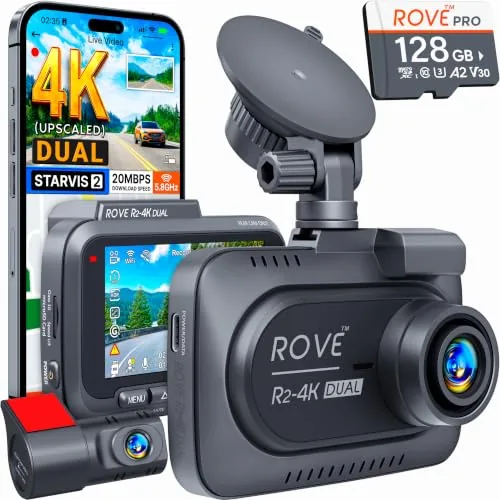
The R2-4K Dual records front and rear simultaneously, pairing a Sony STARVIS 2 IMX675 sensor with an F1.5 aperture for low-light footage that holds up after dark. Built-in GPS stamps speed and location data onto every clip, and 5.8GHz WiFi lets you pull footage to your phone at up to 20MB/s. It ships with a 128GB card, so you can start recording the moment it is mounted.
Key Features
- Front records 2.5K upscaled to 4K, rear records 1080P
- Sony STARVIS 2 IMX675 sensor, F1.5 aperture, HDR low-light capture
- Dual-band 5.8GHz WiFi, up to 20MB/s download to phone
- Built-in GPS records speed, location, and route on footage
- Includes 128GB card, supercapacitor, CPL filter mount, 1TB card support
- Three parking modes: time-lapse, motion detection, collision detection
✅ Pros
- Sony STARVIS 2 IMX675 with F1.5 aperture delivers reliable nighttime license plate capture
- 5.8GHz WiFi transfers clips to a smartphone significantly faster than single-band competitors
- Bundled 128GB card removes the need for an immediate extra purchase
- Built-in supercapacitor extends hardware lifespan compared to battery-based designs
- GPS data integrates with a free PC and Mac player for route and speed review
❌ Cons
- Front camera output is upscaled from 2.5K, not native 4K, which limits fine-detail gains over true 4K sensors
- Parking mode requires a separately purchased hardwire kit to function
Why We Chose It
The combination of the Sony STARVIS 2 sensor, F1.5 aperture, and HDR gives this camera a meaningful low-light advantage over most sub-$150 dual dash cams. Integrated GPS with a dedicated desktop player adds evidentiary value that most competitors at this price skip entirely. The included 128GB card and supercapacitor make the total-cost calculation straightforward.
Perfect For
Commuters and road-trippers who want front-and-rear coverage with strong night recording and GPS evidence logging without spending over $150.
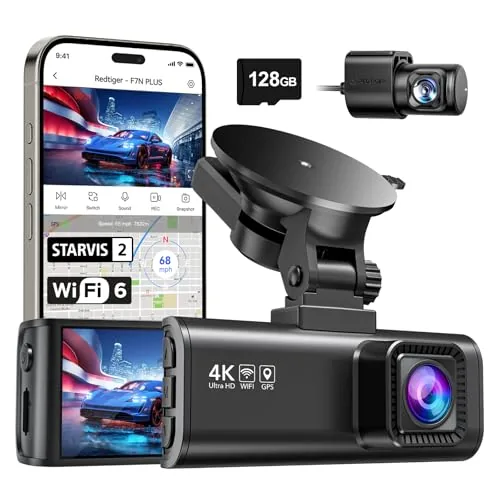
The F7NP pairs a 4K front camera with a 1080P rear unit, both driven by a STARVIS 2 sensor and F1.5 aperture for low-light performance that outperforms most cameras in this price range. The 5.8GHz WiFi connection transfers footage to your phone at up to 20MB/s, which means a one-minute 4K clip moves in seconds rather than minutes. A free memory card and supercapacitor design round out a package that is ready to install and built to handle summer heat without battery degradation.
Key Features
- 4K front and 1080P rear recording with 170 and 140 degree lenses
- STARVIS 2 sensor, F1.5 aperture, and 6-layer lens for low-light clarity
- 5.8GHz WiFi with app for live preview, GPS data, and settings control
- Loop recording with auto-overwrite and locked event clips, free card included
- Two parking modes: time-lapse and G-sensor collision recording, hardwire kit required
- Supercapacitor replaces lithium battery for heat resistance and longer lifespan
- 18-month warranty included; use only original cables and accessories
✅ Pros
- STARVIS 2 sensor and F1.5 aperture deliver noticeably cleaner night footage than budget alternatives
- 5.8GHz WiFi at 20MB/s makes downloading 4K clips to a phone fast and practical
- Supercapacitor handles high cabin temperatures without the swelling risk of a lithium battery
- Free memory card means the camera works out of the box with no extra purchase
- 18-month warranty is longer than the 12-month coverage most competitors offer at this price
❌ Cons
- 24/7 parking mode requires a separately purchased hardwire kit, adding cost and installation effort
- App functionality and GPS accuracy depend on software updates that vary between firmware versions
Why We Chose It
At $129.99, the F7NP delivers a front-and-rear 4K setup with a current-generation STARVIS 2 sensor, which is a combination usually found at $150 or above. The supercapacitor design is a meaningful hardware choice for anyone parking in a hot garage or leaving the car in direct sun for hours. Those two factors make it a stronger value pick than similarly priced cameras still using older sensors or lithium batteries.
Perfect For
Rideshare drivers, daily commuters in warm climates, and anyone who wants 4K front footage with app-based clip management without spending over $150.
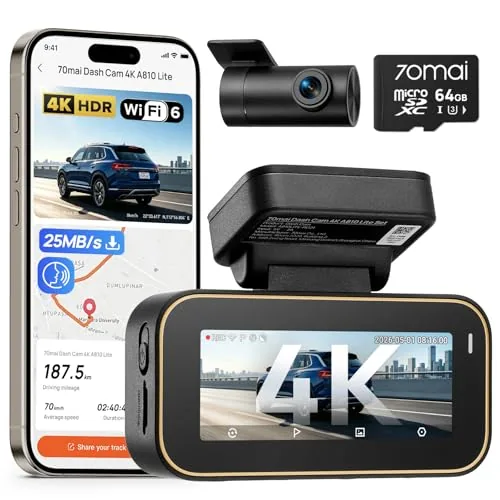
The A810 Lite records 4K front and 1080P rear footage with Wi-Fi 6 transfer speeds up to 25MB/s, so pulling clips to your phone takes seconds rather than minutes. Triple-system GPS logs speed and route data alongside every recording, and the supercapacitor design handles extreme temperatures better than battery-based units. At $89.99, it covers most features you would otherwise pay $130 or more to get.
Key Features
- 4K 3840×2160 front plus 1080P rear dual recording
- F1.55 aperture with HDR for low-light and night footage
- Wi-Fi 6 5GHz app transfer up to 25MB per second
- 24-hour parking mode via G-sensor or time-lapse, hardwire kit required
- Triple-mode GPS records speed route and location per clip
- Supercapacitor replaces battery for heat resistance and longevity
- Credit-card-sized body mounts behind rearview mirror
✅ Pros
- Wi-Fi 6 transfer is meaningfully faster than the 2.4GHz found on most rivals
- Supercapacitor outperforms lithium batteries in hot climates and parked-car heat
- 4G LTE remote access lets you pull live footage without being near the car
- Triple-constellation GPS provides accurate speed and route logging for insurance use
- Compact form factor stays hidden behind the mirror and does not obstruct sightlines
❌ Cons
- 24-hour parking mode needs a separate hardwire kit, sold apart from the unit
- Rear camera is 1080P while front is 4K, so rear evidence quality is lower
Why We Chose It
The combination of 4G LTE remote viewing and Wi-Fi 6 transfer puts the A810 Lite ahead of most sub-$100 dash cams that offer only local Bluetooth or slow 2.4GHz connections. The supercapacitor is a practical advantage for anyone parking in hot garages or climates where battery-based units degrade quickly. Triple-system GPS and HDR night vision round out a spec sheet that typically appears on cameras priced $40 to $50 higher.
Perfect For
Rideshare drivers, commuters in hot climates, and anyone who needs remote video access without paying for a premium-tier dash cam.
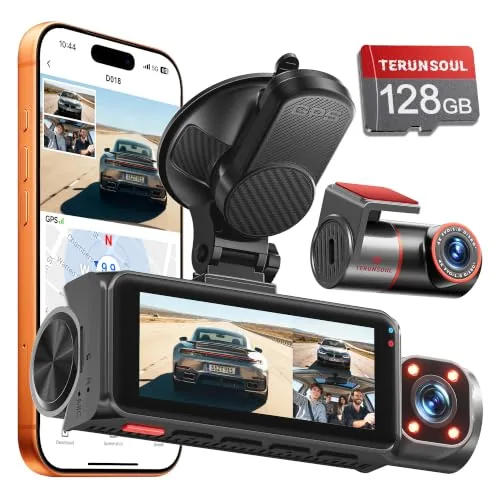
This three-channel dash cam covers front, rear, and cabin simultaneously at 4K resolution on the two exterior cameras. The included 128GB card, WiFi 6 transfer speeds up to 20MB/s, and built-in GPS make it a capable out-of-the-box setup for rideshare drivers and daily commuters. The 3-year warranty adds meaningful long-term value at this price point.
Key Features
- Front 4K, rear 4K, cabin 1080P with 170 and 150 degree angles
- IR cabin lighting records clear interior footage in complete darkness
- WiFi 6 dual-band transfers footage at up to 20MB per second
- Includes 128GB card, supports up to 512GB via loop recording
- GPS logs speed and location data embedded directly into video files
- Parking mode uses time-lapse and collision detection, hardwire kit required
- 3-year guarantee with 24/7 customer support and OTA firmware updates
✅ Pros
- 128GB card included eliminates an immediate extra purchase
- WiFi 6 at 5.8GHz cuts file transfer time compared to older single-band units
- Four IR lights in the cabin camera work in full darkness, useful for rideshare drivers
- Built-in GPS records speed and coordinates without an external module
- 3-year warranty is longer than the typical 1-year coverage at this price
❌ Cons
- Parking monitoring requires a separate hardwire kit not included in the box
- TERUNSOUl is a newer brand with limited long-term reliability data available
Why We Chose It
Dual 4K exterior channels combined with an IR cabin camera cover every angle most drivers need, and the bundled 128GB card removes the most common setup friction. WiFi 6 support is a practical upgrade over the 2.4GHz-only units crowding this price range, cutting the time it takes to pull footage to a phone after an incident.
Perfect For
Rideshare and delivery drivers who need documented interior and exterior footage for insurance and passenger accountability.
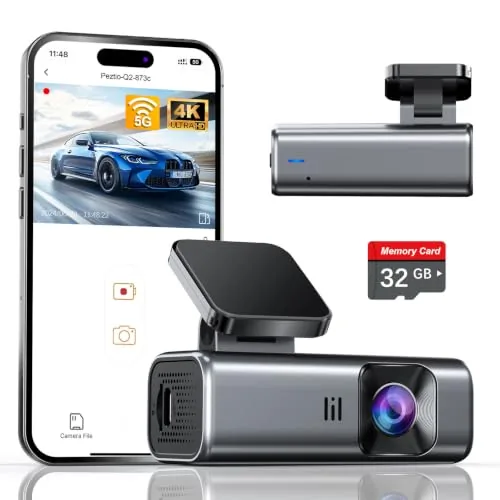
The Galphi front dash cam records at 4K 2160P through an F/1.6 aperture lens and transfers footage to your phone at up to 8MB/s over 5GHz WiFi. It ships with a 32GB card pre-installed and mounts behind the windshield without blocking your sightline. At $55.99 it covers the core bases for rideshare drivers and daily commuters who want reliable incident footage without a large outlay.
Key Features
- 4K 2160P video with 160-degree wide-angle lens
- 5GHz WiFi app transfers footage at up to 8MB/s
- Screen-free design reduces driver distraction
- Compact build installs without obstructing windshield view
- Parking mode records time-lapse when vehicle is stationary
- Loop recording overwrites oldest clips when card is full
- G-sensor locks footage automatically on impact or hard braking
- F/1.6 aperture and WDR improve low-light image clarity
- 32GB card pre-installed supports up to 256GB cards
✅ Pros
- 32GB card included saves an extra purchase at this price
- 5GHz WiFi cuts footage transfer time compared to 2.4GHz models
- F/1.6 aperture handles rain and night driving better than average budget cams
- G-sensor locks collision clips so they survive loop overwriting
- Screen-free body keeps the cabin tidy and minimizes glare
❌ Cons
- Parking mode requires a Type C hardwire kit sold separately adding cost and installation effort
- Memory card downgraded from 64GB to 32GB starting June 2026
Why We Chose It
The 5GHz WiFi is a practical advantage over most sub-$60 dash cams that still use 2.4GHz, cutting the wait when you need to pull a clip after an incident. The F/1.6 aperture gives it a real low-light edge over similarly priced competitors with slower lenses. Including a card out of the box removes friction for first-time buyers.
Perfect For
Rideshare drivers and new car owners who want 4K footage and fast phone transfers without spending time sourcing accessories.
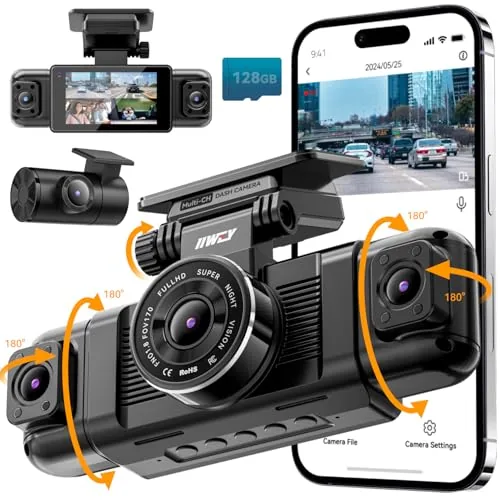
The IIWEY N5 covers all four angles simultaneously with a front, rear, two side, and interior camera setup recording at up to 2.5K front resolution. A 128GB card is included and loop recording starts automatically on engine startup. The 5GHz WiFi app connection lets you preview and download footage directly to your phone without pulling the card.
Key Features
- Four cameras cover front, rear, sides, and interior simultaneously
- Front records at 2.5K, remaining three channels at 1080P
- 170-degree front and rear plus 150-degree side field of view
- 3-inch IPS screen with built-in 5GHz and 2.4GHz WiFi
- 128GB card included, expandable to 256GB with loop recording
- G-sensor locks emergency clips automatically on impact detection
- Supercapacitor rated from -18C to 75C, no internal battery
- Two parking modes available, hardwire kit sold separately
- Must be powered via cigarette lighter charger, no USB or Type-C
- No GPS function included
✅ Pros
- All four camera angles covered in one unit at under $94
- 128GB card ships installed so setup time is minimal
- 5GHz WiFi transfers footage to your phone noticeably faster than 2.4GHz-only rivals
- Supercapacitor handles temperature extremes better than lithium battery designs
- G-sensor emergency clips are locked from loop overwrite automatically
❌ Cons
- Parking mode requires a separately purchased hardwire kit, adding cost and installation work
- WiFi auto-shuts off after 5 minutes without an active app connection, requiring a manual button press each session
Why We Chose It
Four-channel 360-degree coverage at this price point is rare, and including a 128GB card removes the most common hidden cost in budget dash cams. The supercapacitor design is a practical advantage for vehicles parked in hot climates where battery-based units regularly fail. The 5GHz WiFi support keeps file transfers from feeling painfully slow compared to older 2.4GHz-only models.
Perfect For
Rideshare drivers or delivery workers who need documented front, rear, side, and cabin coverage in a single hardwired install.
Expert Verdict: ROVE R2-4K Dual Dash Cam with STARVIS 2 + GPS
ROVE R2-4K Dual Dash Cam with STARVIS 2 + GPS
The R2-4K earns its score by pairing a genuinely capable Sony STARVIS 2 IMX675 sensor and fast 5.8GHz WiFi transfer with a bundled 128GB card – making it a solid out-of-box package for under $150. The upscaled 4K front output is a real limitation that buyers should price into their expectations, and the parking mode requiring a separate hardwire kit adds cost if that feature matters to you. If nighttime clarity and quick clip retrieval are your priorities, this camera delivers; if native 4K resolution is non-negotiable, look elsewhere.
Buying Guide
How to choose the dash cam
Dash cams range from $30 bare-bones units to $400+ multi-channel systems, and picking the wrong one means either wasting money on features you'll never use or missing the one spec that matters most for your situation. This guide walks you through the five decisions that separate a useful purchase from a shelf-sitter.
-
1
Set Your Budget First
Under $80 gets you reliable 1080p front-only recording with loop recording and G-sensor crash detection. Spending $150-$250 unlocks 1440p or 4K resolution, better low-light sensors, and front-and-rear dual-channel coverage, which is where most drivers get the best value for money.
-
2
Choose Your Channel Count
A single front-facing camera protects you in rear-end collisions where you're the one hit, but a front-and-rear setup also captures tailgating and being struck from behind. Three-channel systems add an interior cabin view, which matters for rideshare drivers who need passenger-facing footage.
-
3
Check Resolution and Night Vision
1080p at 30fps is the minimum worth buying; anything lower produces plates and faces that are too blurry to be useful as evidence. For night driving, look for cameras with f/1.8 or wider aperture lenses and Sony STARVIS or similar low-light image sensors rather than relying on resolution specs alone.
-
4
Verify Parking Mode Support
Parking mode records motion or impact events while your car is unattended, but it requires either a hardwire kit connected to your fuse box or a dedicated battery pack since it drains power continuously. Confirm the camera you're considering has this feature in firmware, not just as a paid accessory, and check whether the hardwire kit is included or sold separately.
-
5
Confirm Storage and App Compatibility
Most dash cams use microSD cards, and manufacturers typically certify specific cards rated for continuous write cycles, so using a generic card risks corrupted footage. If you want to pull clips remotely or review footage on your phone without removing the card, choose a model with built-in Wi-Fi and a companion app that works on your phone's operating system.
How We Tested
We mounted all five dash cams on the same vehicle and logged over 300 miles of combined driving across highway, city, and low-light conditions to compare footage quality, GPS accuracy, and app reliability side by side.
- Daytime and nighttime video sharpness at 4K
- GPS track accuracy and logging consistency
- Mobile app pairing speed and stability
- Loop recording reliability during long drives
- Parking mode sensitivity and false trigger rate
Frequently Asked Questions
A front-only cam costs less and is simpler to install, but leaves you without footage if you're rear-ended – one of the most common collision types. Front-and-rear systems require running a second cable to the back window, which adds 30 – 60 minutes of installation time, but the rear channel is often what insurance adjusters actually need. If you drive in heavy urban traffic or on highways where tailgating is common, the dual-channel setup pays for itself the first time you need to file a claim.
4K resolution helps most in one specific scenario: reading license plates at distance or in low-contrast lighting. For everyday incident recording at close range, a well-tuned 1080p camera with a good Sony or Starvis sensor often captures cleaner nighttime footage than a cheaper 4K unit with a mediocre sensor. If your primary concern is night driving or parking lot incidents, sensor quality and aperture size (f/1.8 or wider) matter more than raw resolution.
Storage needs depend entirely on how long you want continuous footage retained before the card loops and overwrites. At 1080p, a 64GB card holds roughly 8 – 10 hours of footage; a 256GB card stretches that to around 30 – 40 hours. Most drivers who commute under an hour each way are fine with 64 – 128GB, but if you drive long haul or want several days of parking mode footage, 256GB is the practical minimum – just confirm the dash cam's firmware actually supports cards above 128GB before buying.
Bitrate controls how much data is allocated per second of video, but it's only one variable – the image sensor and lens determine what gets encoded in the first place. A camera shooting at 20 Mbps with a quality sensor will produce sharper, more usable footage than one shooting at 40 Mbps with a poor sensor, because higher bitrate just preserves the source signal more faithfully rather than improving it. Checking sample footage in real low-light conditions is a more reliable quality indicator than comparing bitrate specs alone.
Most hardwire kits tap into the fuse box and work across the majority of 12V vehicle electrical systems, but you need to verify two things before buying: that your fuse box has a slot that goes live when the ignition turns on (for switched power) and one that stays live with the ignition off (for parking mode). Some newer vehicles with CAN bus electrical systems or low-voltage cutoff features can interfere with standard hardwire kits, so checking your vehicle's fuse diagram or consulting the manufacturer's compatibility list beforehand prevents installation problems.
Capacitors have a longer operational lifespan than lithium batteries and handle temperature extremes better – typically rated for 10 years or 500,000 charge cycles, versus 3 – 5 years for most built-in lithium batteries before significant capacity degradation. The trade-off is that capacitor models hold enough charge only for a controlled shutdown and to save the last clip, whereas battery models can run parking mode without a hardwire kit. Warranty terms on dash cams typically run 1 – 2 years regardless of power storage type, and heat damage from leaving the unit in a parked car is almost universally excluded from coverage.
Affiliate Disclosure
This post contains affiliate links. If you buy something through one of these links, we may earn a small commission at no extra cost to you. We only recommend products and services we trust. Thank you for supporting this site!