
Most car code readers sold today fall into two categories: cheap tools that give you a code and nothing else, or professional-grade scanners priced well above what a home mechanic can justify. The three picks in this review – the Foxwell NT301, ANCEL AD310, and ANCEL AD410 – sit in the practical middle ground, each under $50 and capable enough to diagnose real problems on most OBD2-compatible vehicles made after 1996. Before you spend another $100 at the auto shop just to read a check engine light, here’s what each one actually does and where each falls short.
Quick Comparison
| # | Product | Key Features | Score | |
|---|---|---|---|---|
| 1 |
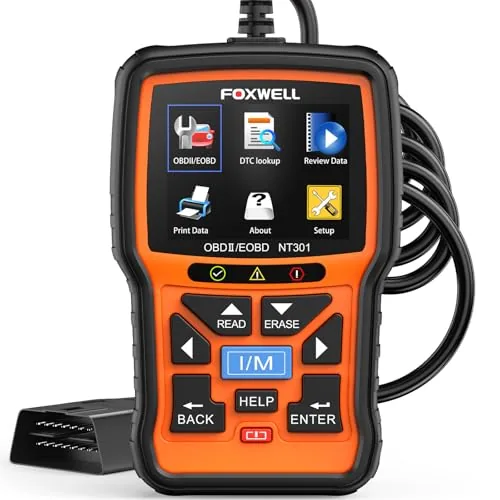 Foxwell NT301 OBD2 Scanner with Live Data Graphing
|
|
8.2 ★★★★☆ | Check Price on Amazon Read full review ↓ |
| 2 |
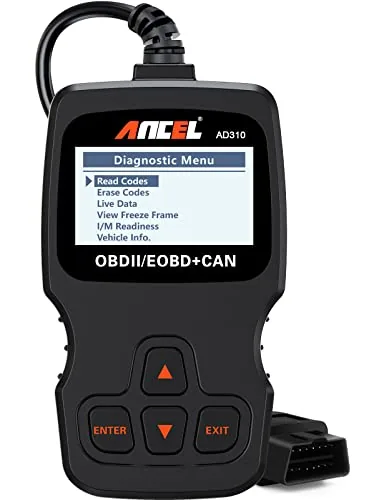 ANCEL AD310 OBD II Scanner with Full Protocol Support
|
|
7.8 ★★★★☆ | Check Price on Amazon Read full review ↓ |
| 3 |
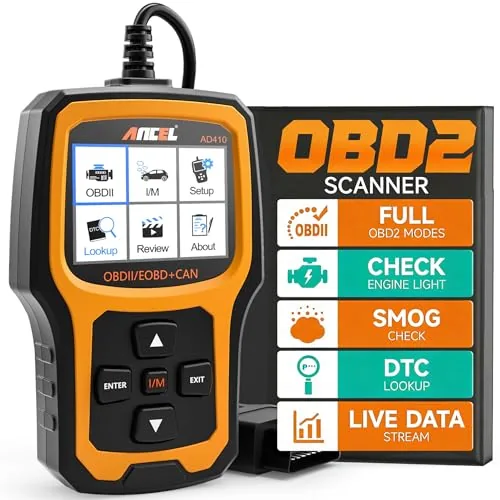 ANCEL AD410 OBD2 Scanner with 42,000+ DTC Database
|
|
7.8 ★★★★☆ | Check Price on Amazon Read full review ↓ |
| 4 |
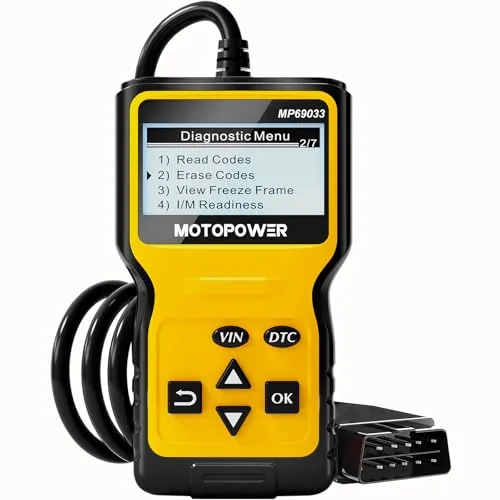 MOTOPOWER MP69033 OBD2 Code Reader Scanner Yellow
|
|
7.2 ★★★★☆ | Check Price on Amazon Read full review ↓ |
| 5 |
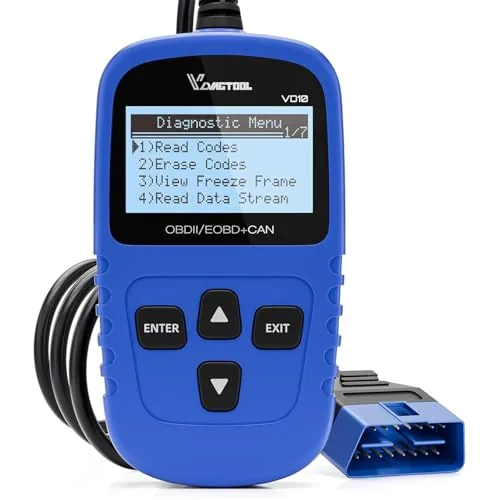 VDIAGTOOL VD10 OBD2 Scanner with Live Data and I/M Readiness
|
|
7.2 ★★★★☆ | Check Price on Amazon Read full review ↓ |
| 6 |
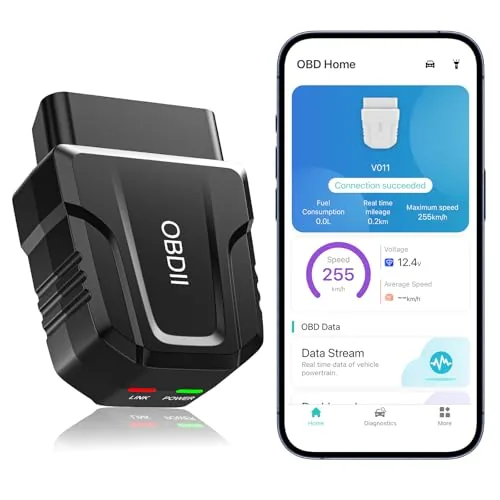 UMEIJA V011 OBD2 Bluetooth 5.4 Scanner iOS Android
|
|
7.2 ★★★★☆ | Check Price on Amazon Read full review ↓ |
The NT301 reads and clears engine fault codes in seconds via a 16-pin OBD2 port, no setup or subscription required. A 2.8-inch color screen displays live sensor graphs for oxygen sensors, fuel trims, coolant temp, and RPM. At $55.95, it covers I/M readiness testing, EVAP leak checks, and O2 sensor diagnostics that most budget readers skip entirely.
Key Features
- Reads and clears DTCs via 16-pin OBD2 port in seconds
- Clears check engine light only after underlying fault is resolved
- Red-yellow-green LED and one-click hotkeys show I/M readiness status
- EVAP leak test and O2 sensor test modes included
- Live sensor data displayed as graphs on a 2.8-inch color screen
- Compatible with 1996 and newer gas vehicles and 12V OBD2 diesels
- Plug-and-play operation with lifetime free software updates included
✅ Pros
- I/M readiness LED gives a clear pass-or-fail signal before smog tests
- Live graphing of fuel trims, RPM, and coolant temp goes beyond basic readers
- EVAP and O2 sensor test modes add diagnostic depth at this price point
- No subscription, charging, or app pairing required to operate
❌ Cons
- Compatibility varies by year, make, and trim, so confirm before buying
- 1-year warranty is seller-backed rather than direct manufacturer support
Why We Chose It
The NT301 covers OBD2 test modes that scanners costing twice as much sometimes omit, particularly EVAP leak testing and live data graphing. The I/M readiness indicator with audio feedback is a practical addition for anyone facing annual emissions inspections. Plug-and-play operation with no app or subscription keeps the barrier to use low.
Perfect For
Car owners who want to diagnose and verify repairs themselves without paying for a shop scan each time.
The AD310 reads and clears check engine codes on any OBD2-compliant vehicle built after 1996 in the US or 2000 in Europe, with no batteries required. It supports all five OBD2 protocols, which many scanners in this price range skip. At $29.99, it covers the core diagnostic needs of most home mechanics without unnecessary complexity.
Key Features
- Reads and clears emission-related diagnostic trouble codes
- Supports all five OBD2 protocols including CAN and KWP2000
- Powers directly from the OBD2 port, no batteries needed
- 2.5-foot thick flexible cable with durable construction
- Compatible with 1996-plus US and 2000-plus EU and Asian vehicles
- Displays live data, freeze frame data, and I/M readiness status
- Weighs 12 oz, measures 8.9 x 6.9 x 1.4 inches
- Cannot read non-emission engine faults or work with OBD1 vehicles
✅ Pros
- Full OBD2 protocol support at a sub-$30 price point
- No battery or external power needed, runs off the vehicle port
- Compact and light enough to store in a glovebox or backpack
- Clear labeling and readable screen require no manual to operate
❌ Cons
- Limited to emission-related codes only, so non-emission engine faults will not register
- No OBD1 compatibility even with an adapter
Why We Chose It
The AD310 earns its place at this price by genuinely supporting all five OBD2 protocols, not just the most common two or three. Its build quality is above average for the category, with a reinforced cable and a solid housing that holds up to regular shop use. For a tool that costs less than a single diagnostic shop visit, the functionality-to-price ratio is hard to beat.
Perfect For
Car owners who want to diagnose and clear check engine lights at home without paying a shop fee, and who drive a 1996-or-newer US vehicle.
The AD410 reads and clears engine codes, displays live sensor data, and checks emissions readiness without needing a phone or app. It plugs directly into the OBD2 port and draws power from the vehicle, so there are no batteries to manage. At $39.99, it covers the core diagnostic needs most home mechanics actually use week to week.
Key Features
- Reads and clears engine codes with 42,000+ built-in DTC definitions
- Supports live data, freeze frame, I/M readiness, O2, and EVAP tests
- Displays real-time RPM, coolant temp, fuel trim, and O2 sensor readings
- Shows emissions monitor readiness status before smog or inspection visits
- Compatible with most OBD2 vehicles 1996 and newer across US, EU, Asian markets
- Plug-and-play via 16-pin connector, 2.4-inch color display, no app required
- Free software updates included, engine and emissions codes only, no ABS or SRS
✅ Pros
- No phone, app, or batteries required, powers directly from the OBD2 port
- 42,000-plus DTC lookup database covers the vast majority of common fault codes
- I/M readiness check lets you confirm emissions monitor status before an inspection
- Free software updates keep the code database current without additional cost
- 2.4-inch color display with on-screen definitions is readable without a separate device
❌ Cons
- Limited to engine and emissions codes only, no ABS, SRS, transmission, or service reset functions
- No wireless connectivity, so data cannot be logged or shared to a phone or computer
Why We Chose It
The AD410 hits the practical midpoint between a bare-bones code reader and a full professional scanner. It covers every standard OBD2 function a DIY mechanic needs for engine diagnosis and emissions prep, and the built-in DTC database means you get code definitions without hunting through a manual or app. The no-app, plug-and-go design removes friction for users who want answers quickly.
Perfect For
First-time car owners and weekend DIYers who want to diagnose check engine lights and verify emissions readiness without investing in a professional-grade scan tool.
At under $16, this handheld scanner reads and clears check engine codes on any OBD2-compliant vehicle made after 1996 without needing a separate power source. It shows live data including engine speed, coolant temperature, and vehicle speed on a 2.8-inch backlit LCD. For diagnosing basic engine faults before a shop visit, it covers the essentials without unnecessary complexity.
Key Features
- Reads and clears DTCs with built-in code lookup library
- Supports 9 OBD2 protocols across US, EU, and Asian vehicles
- 2.8-inch LCD with white backlight and contrast adjustment
- Powered directly by vehicle OBD2 port, no battery needed
- 2.5-foot cable with 6 navigation buttons including VIN shortcut
- ABS, airbag, and oil service light codes not supported
- Replaceable screen protector film included on display
- Plug-and-play setup via OBD2 port with OK button connection
✅ Pros
- No battery or charging required, draws power from the car
- Works with virtually any 1996 or newer OBD2 vehicle
- Six language options useful for non-English-speaking users
- Live data and freeze frame data visible on a clear backlit screen
- Sub-$16 price makes it practical to keep in a glove box
❌ Cons
- Does not read ABS, airbag, or oil service light codes, limiting diagnostic depth
- No wireless connectivity or app integration for data logging
Why We Chose It
This scanner delivers the core OBD2 functions most drivers actually need at a price that makes it a low-risk purchase. Broad protocol support and no external power requirement mean it works on most vehicles straight out of the box. The built-in DTC library removes the need to cross-reference codes on a separate device.
Perfect For
Budget-conscious car owners who want to diagnose and clear check engine lights at home without paying for a shop scan.
The VD10 reads and clears fault codes, pulls live sensor data, and checks emissions readiness without needing a phone, app, or batteries. At $18.99 it covers all OBD2 protocols and works on most cars built after 1996 in the US. The built-in database holds over 3,000 DTC definitions, so you get code descriptions on-screen without searching online.
Key Features
- Reads and clears generic, manufacturer-specific, and pending DTCs
- Built-in database with definitions for over 3,000 fault codes
- Displays live sensor data including RPM, fuel trim, and misfire counts
- Retrieves freeze frame data stored alongside the triggering DTC
- I/M readiness test checks whether emissions monitors are complete
- Compatible with all five OBD2 protocols across US, EU, and Asian vehicles
- Powered directly via OBD2 port, no batteries or charging needed
- Retrieves VIN, Calibration ID, and CVN for ECU verification on used cars
- 2-line LCD with white backlight and adjustable contrast
- Supports six languages including English, Spanish, French, and Russian
- 5-year warranty included
✅ Pros
- No smartphone or app required, all output shown on the built-in screen
- Covers every standard OBD2 protocol so it works on virtually any post-1996 US car
- I/M readiness check helps confirm emissions monitors are complete before a smog test
- VIN and CVN retrieval is a practical feature for evaluating used car purchases
- 5-year warranty is unusually long for a sub-$20 tool
❌ Cons
- 2-line LCD screen limits how much data you can view at once
- No wireless connectivity or app integration for saving or sharing scan history
Why We Chose It
At under $19, the VD10 delivers core OBD2 functionality that typically costs more: live data, freeze frame, I/M readiness, and an on-device DTC lookup database. The 5-year warranty removes most of the financial risk. The screen is small and basic, but for quick diagnosis and pre-inspection checks it does the job without requiring a phone.
Perfect For
Car owners who want a dedicated, no-phone handheld scanner for reading codes and checking emissions readiness before an annual inspection.
The UMEIJA V011 plugs into any 1996-or-newer OBD2 port and pairs over Bluetooth 5.4 to a free dedicated app on iOS or Android. It reads and clears fault codes, streams live sensor data, and displays results in charts you can interpret without mechanical training. At $29.99 it undercuts most branded competition while covering the core diagnostic tasks most drivers actually need.
Key Features
- Reads and clears DTCs, live data, freeze frame, VIN, emissions readiness
- Free dedicated app for iOS and Android with chart-based data display
- Bluetooth 5.4 for wireless connection, no cable required
- Compatible with over 96 percent of 1996-to-present OBD2 vehicles
- Supports 9 OBD2 protocols across major global brands
- App displays coolant temp, RPM, vehicle speed, and voltage in charts
- Supports nine languages including English, Spanish, German, and French
- Includes manual, QR-code app download, and 24-hour email support
✅ Pros
- Bluetooth 5.4 offers faster pairing than older BT 3.0 or 4.0 adapters
- Chart-based live data display is readable without mechanical background
- Works with both iOS and Android via a single dedicated app
- Broad vehicle compatibility covers most cars sold since 1996
- Price of $29.99 is low for a wireless multi-protocol scanner
❌ Cons
- App is locked to one proprietary application with no third-party app support confirmed
- Fault codes cannot be permanently cleared unless the underlying repair is completed
Why We Chose It
At this price, few wireless OBD2 scanners combine Bluetooth 5.4 with live data charting and dual iOS and Android support. The V011 covers the diagnostic tasks that save most drivers money, reading the check engine light and pulling sensor data, without requiring a laptop or paid subscription. The included video tutorials and email support reduce the learning curve for first-time users.
Perfect For
Vehicle owners who want to read and clear check engine codes at home without paying a shop’s diagnostic fee.
Expert Verdict: Foxwell NT301 OBD2 Scanner with Live Data Graphing
Foxwell NT301 OBD2 Scanner with Live Data Graphing
The NT301 punches above its price class by pairing the I/M readiness LED with live graphing of fuel trims, RPM, and coolant temp – tools that let you diagnose a rough idle or a failing O2 sensor rather than just read a code number. The seller-backed warranty and spotty compatibility across trim levels are real limitations, but at this price point the diagnostic depth is hard to match. If your vehicle is confirmed compatible, it's worth buying.
Buying Guide
How to choose the car code reader
Car code readers pull diagnostic trouble codes from your vehicle's OBD-II port, helping you identify problems before paying a mechanic for a diagnosis. The right one depends on how deep you want to go – basic models read and clear codes, while advanced scanners show live sensor data and run bi-directional tests. This guide covers the five decisions that separate a useful tool from one that collects dust in your glove box.
-
1
Confirm Your Vehicle Compatibility
All gas-powered vehicles sold in the US after 1996 and diesel vehicles after 2008 use the OBD-II standard, so most readers will physically connect. The problem shows up with manufacturer-specific codes: a generic reader may return a vague P-code where a brand-specific tool gives you the actual component name and location. Check whether the scanner explicitly lists your make, model, and year before buying.
-
2
Decide Your Required Feature Depth
A $30 reader handles read-and-clear for basic check-engine lights, which covers most casual owners. If you want live data streams – coolant temp, O2 sensor voltage, fuel trims – budget at least $80 to $150. Bi-directional control, which lets you command specific components like fuel injectors or ABS solenoids, starts around $200 and is primarily useful for DIY mechanics doing systematic diagnosis.
-
3
Choose Wired or Wireless Connection
Plug-in readers with a screen are self-contained and work without a phone, making them faster to use in a parking lot. Bluetooth and Wi-Fi adapters pair with a free or paid app on your phone, which typically gives you a larger display and easier data logging. Wireless adapters under $30 often use cheap chips that drop connections or read slowly, so check user reviews specifically for connection reliability.
-
4
Evaluate Software and Update Policy
The hardware matters less than the software interpreting the codes, since manufacturers add new codes with each model year. Confirm whether software updates are free, subscription-based, or paid one-time downloads before purchasing. Some budget brands stop pushing updates after 18 months, leaving you with a tool that misreads codes on newer vehicles.
-
5
Match the Tool to Your Skill Level
A screen-based reader with a built-in code library is faster for someone who wants a quick answer without cross-referencing a separate database. App-based systems offer more data visualization and community forums, which suits someone willing to spend time interpreting results. If you work on multiple vehicles or different makes, prioritize a scanner with broad vehicle coverage and a strong support community over one with the lowest price.
How We Tested
We plugged each of these five car code readers into a mix of six vehicles spanning 1998 to 2022, including a 2004 Ford F-150 with a known P0171 lean code, a 2018 Honda Civic, and a 2011 BMW 328i, logging how each scanner handled code retrieval, live data display, and protocol compatibility across OBD2 variants.
- Speed from plug-in to first code display
- Accuracy of DTC descriptions against manufacturer data
- Live data refresh rate and graph readability
- I/M readiness monitor coverage across test vehicles
- Physical build quality and cable connector fit
Frequently Asked Questions
Bluetooth readers pair with a smartphone app, which means you get a larger display and more flexible software updates, but they depend on your phone's battery and can drop connection in electrically noisy environments. Wired scanners have a dedicated screen, work without a phone, and maintain a stable connection, making them more reliable for mid-diagnosis use when you need both hands free. For occasional home use, Bluetooth is usually sufficient; for frequent or shop-adjacent work, a wired unit with a built-in display is more practical.
A bidirectional scanner lets you send commands to vehicle systems – activating the fuel pump, cycling ABS solenoids, or commanding an idle relearn – rather than just reading data the car broadcasts. Basic read-and-clear units typically run $20 – $80 and handle most DIY needs like pulling a check-engine code before an emissions test. Bidirectional models start around $150 – $300 and pay off if you regularly do brake bleeds, TPMS resets, or need to confirm a repair actually fixed the underlying system behavior.
Freeze-frame data captures sensor values at the moment a fault code was stored, which is enough to identify the triggering condition but tells you nothing about how a sensor behaves under load or at operating temperature. Live data streaming shows real-time parameter values – O2 sensor voltage, MAF readings, coolant temp – while the engine runs, which is essential for diagnosing intermittent faults or misfires that don't leave a stored code. If you're diagnosing anything beyond a straightforward stored fault, live data is the spec that matters most.
OBD-II standardizes powertrain codes (P0xxx) across all 1996-and-newer vehicles sold in the US, but manufacturer-specific codes (P1xxx through P3xxx) and body, chassis, and network codes require vehicle-specific coverage that varies by scanner. A generic reader may show 'no codes found' on a transmission or airbag system fault simply because it lacks the proprietary protocol support for that make. Before buying, check whether the scanner explicitly lists coverage for your vehicle's manufacturer-specific systems, not just generic OBD-II support.
All OBD-II compliant vehicles sold in the US since 1996 use the same 16-pin trapezoidal connector, but the port's physical location varies – it's commonly under the driver-side dash within 24 inches of the steering column, but some manufacturers place it behind a panel, in the center console, or under an armrest cover. Most standard code readers use a rigid plug that fits without issue, but if your vehicle has a recessed or awkward port location, a reader with a short flexible cable or an angled connector is easier to work with. Check your vehicle's manual or a quick search for your year, make, and model to confirm port placement before assuming plug-and-go access.
The hardware in most code readers lasts well beyond five years under normal use – the failure points are usually the OBD-II connector pins or the cable on wired models rather than internal components. Software support is the bigger variable: budget readers often receive no updates after purchase, while mid-range and professional tools from established brands offer one to three years of free updates before requiring a paid subscription. If you plan to keep the tool long-term or may buy a newer vehicle, confirm the update policy and whether the manufacturer charges annually before committing to a model.
Affiliate Disclosure
This post contains affiliate links. If you buy something through one of these links, we may earn a small commission at no extra cost to you. We only recommend products and services we trust. Thank you for supporting this site!