
If you’re shopping for a launch scanner, the options range from a capable wireless code reader for weekend DIYers to a full-coverage professional diagnostic tool that handles ECU programming and J2534 passthrough. The three scanners reviewed here – the CRP919XBT, the X431 PRO3 V+ Elite, and the X431 PAD VII Elite – cover that entire range, with prices and feature sets to match. Knowing which one fits your workflow comes down to the vehicles you work on, how deep you need to go into module-level diagnostics, and whether you need a portable handheld or a shop-grade tablet.
Quick Comparison
| # | Product | Key Features | Score | |
|---|---|---|---|---|
| 1 |
 LAUNCH CRP919XBT Wireless Bidirectional OBD2 Scanner
|
|
8.5 ★★★★☆ | Check Price on Amazon Read full review ↓ |
| 2 |
 LAUNCH X431 PRO3 V+ Elite with J2534 SmartLink C
|
|
8.4 ★★★★☆ | Check Price on Amazon Read full review ↓ |
| 3 |
 LAUNCH X431 PAD VII Elite J2534 Diagnostic Scanner
|
|
8.4 ★★★★☆ | Check Price on Amazon Read full review ↓ |
| 4 |
 LAUNCH CRP123X V3.0 OBD2 Scanner with Lifetime Updates
|
|
8.2 ★★★★☆ | Check Price on Amazon Read full review ↓ |
| 5 |
 LAUNCH CRP919EBT Bidirectional OBD2 Scanner 2026
|
|
8.2 ★★★★☆ | Check Price on Amazon Read full review ↓ |
| 6 |
 LAUNCH CRP123I V3.0 OBD2 Scanner with 7 Resets
|
|
8.2 ★★★★☆ | Check Price on Amazon Read full review ↓ |
| 7 |
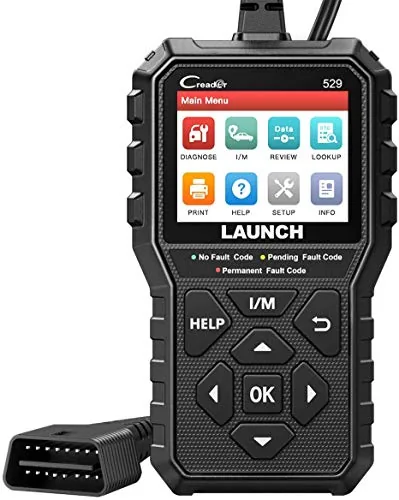 LAUNCH CR529 OBD2 Scanner with Live Data and Free Updates
|
|
7.8 ★★★★☆ | Check Price on Amazon Read full review ↓ |
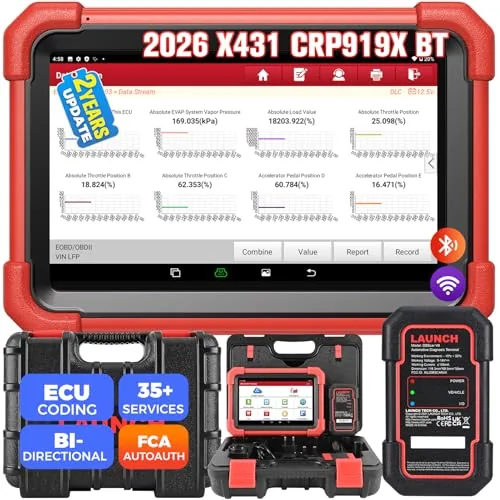
The CRP919XBT delivers professional-grade diagnostics at a mid-tier price, pairing wireless VCI connectivity with ECU coding and 35-plus reset functions. It covers 99 percent of vehicles and supports modern protocols including CANFD and DoIP for late-model GM, Chrysler, BMW, and Jaguar platforms. Built-in FCA AutoAuth handles 2018-plus Stellantis gateway vehicles without extra adapters.
Key Features
- Wireless DBSCar VII VCI transmits data at up to 3Mbps
- Supports CANFD for 2020-plus GM and Chrysler models
- DoIP protocol coverage for Volvo BMW F/G and Jaguar Land Rover
- Integrated FCA AutoAuth for 2018-plus SGW-equipped vehicles
- ECU coding for VW Audi Skoda Ford Lincoln and Mazda
- 35-plus shortcut reset services including oil brake and throttle
- 100-plus additional resets accessible via brand-specific system menus
- Bidirectional control of solenoids relays fans throttle lights and mirrors
- V.A.G guided diagnostics skips security access code lookup
- AutoVIN and AutoScan speeds up full-system module scanning by 3x
- MTK chip with doubled memory and battery versus previous generation
- 2 years of software updates included covering growing car and function list
- Access to LAUNCH technician support via email around the clock
✅ Pros
- Wireless VCI removes cable clutter and lets you move freely around the vehicle during diagnostics
- CANFD DoIP and AutoAuth support covers most protocol gaps found on tools in this price range
- ECU coding and 35-plus reset shortcuts reduce time spent navigating deep menus
- V.A.G guided workflow eliminates manual security access code lookup for VW group vehicles
- Two years of software updates included adds roughly 300 dollars of ongoing value
❌ Cons
- At 529 dollars it sits above entry-level bidirectional tools and requires a meaningful upfront investment
- Software update subscription expires after two years and renewal cost is not disclosed upfront
Why We Chose It
The CRP919XBT sits at a useful intersection of price and capability, offering wireless operation, modern protocol support, and ECU coding that most sub-400-dollar tools omit. The bundled two-year update subscription and built-in FCA AutoAuth reduce the accessory purchases typically required to reach this feature level. For independent shops handling a mixed vehicle lineup, the broad OEM coverage and bidirectional depth justify the price.
Perfect For
Independent shop technicians and advanced DIYers who regularly work on a mixed domestic and import vehicle lineup and need wireless bidirectional diagnostics with ECU coding without stepping up to a 1000-plus dollar platform tool.
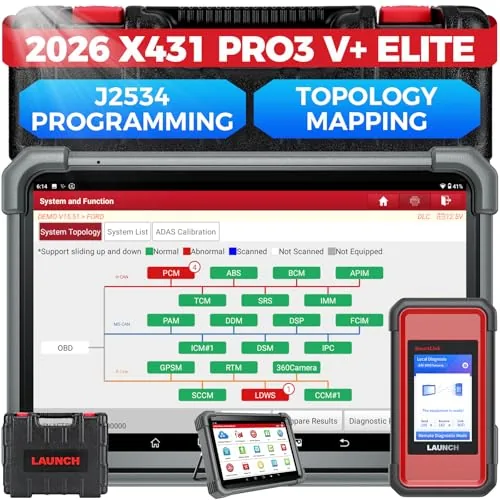
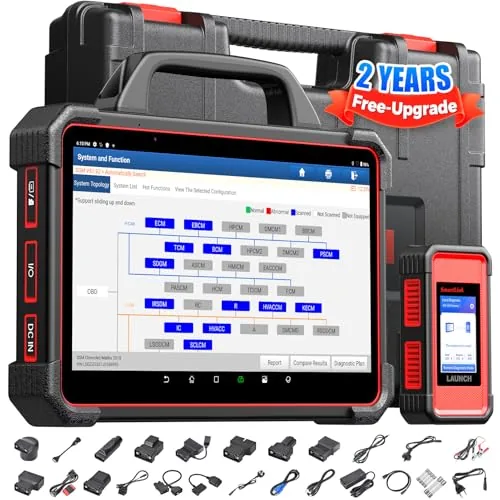
A professional-grade bidirectional scan tool aimed at independent shops needing OEM-level ECU programming without the OEM subscription cost. The J2534 PassThru function via SmartLink C 2.0 eliminates the need for a separate interface device, and full-system topology mapping cuts diagnostic time significantly. Two years of free software updates and a 5-year warranty make the $1,439 price easier to justify.
Key Features
- J2534 PassThru support for OEM-level ECU programming on 10+ brands
- 10.1-inch Gorilla Glass screen, 1280×800 resolution, sunlight readable
- Android 10, quad-core 2.0GHz CPU, 4GB RAM, 64GB storage
- 6300mAh battery, 2.4GHz and 5GHz Wi-Fi, 8MP camera
- 60-plus special reset functions including EPB, BMS, and injector coding
- 3000-plus active tests for bidirectional component control
- Covers 200-plus vehicle brands including NEVs and HD trucks
- CAN FD and DoIP protocols for newer vehicle architectures
- Topology mapping with color-coded ECU network visualization
- 2-year free software updates and 5-year warranty included
✅ Pros
- J2534 PassThru eliminates need for a separate OEM programming interface
- Topology mapping gives a full ECU network view on one screen
- CAN FD and DoIP support covers modern platforms many rivals miss
- 5-year warranty is longer than most competitors in this price range
- 64GB internal storage handles large vehicle data files without external drives
❌ Cons
- HD truck diagnostics require additional software purchases per vehicle brand
- Support contact details in the listing raise authenticity concerns worth verifying before purchase
Why We Chose It
The built-in J2534 PassThru capability is the clearest reason to choose this over comparable tools near the $1,400 mark, since adding a standalone J2534 interface separately typically costs $800 or more. The combination of CAN FD, DoIP, and topology mapping puts it ahead of most tablet-based scanners in its class. The 5-year warranty provides meaningful long-term protection for a workshop investment at this price.
Perfect For
Independent shop owners and advanced DIYers who need OEM-level ECU programming and full bidirectional control across a wide range of domestic and import vehicles without paying for multiple separate tools.
A 13.1-inch tablet-based scanner with 8GB RAM and 256GB storage built for professional shops handling ECU coding, full-system reflashing, and bidirectional testing. The included SmartLink C VCI works wirelessly and doubles as a J2534 PassThru device for OEM software flashing without a dealer-level tool. At $2,699 it targets high-volume workshops where cutting diagnostic time on complex vehicles directly affects revenue.
Key Features
- 13.1-inch display, 8GB RAM, 256GB storage, dual-band WiFi
- SmartLink C VCI supports wireless diagnostics and J2534 PassThru flashing
- Full protocol coverage including J2534, DoIP, and CAN-FD
- AutoVIN identification with full-system scan and topology fault mapping
- ECU coding and 60-plus special service functions including TPMS and BMS
- VAG guided functions and bidirectional active tests for component control
- Compatible with 10-plus add-on modules including oscilloscope and battery tester
- Built-in repair database, training videos, and direct LAUNCH R&D feedback tool
✅ Pros
- J2534 PassThru capability replaces a separate dealer-tier flashing tool
- Topology mapping visually pinpoints fault relationships across modules
- Wireless VCI removes cable management from the diagnostic workflow
- Expandable via 10-plus add-on modules avoiding redundant standalone purchases
- VAG guided security access removes the need to manually input channel codes
❌ Cons
- Some online functions are restricted in the US market, requiring pre-purchase clarification for affected use cases
- Support routes through a third-party e-commerce team rather than LAUNCH Tech USA, which may complicate warranty or escalation
Why We Chose It
The PAD VII Elite combines OEM-level J2534 flashing, topology-based fault mapping, and a modular hardware ecosystem in one device, which few tools at this price point match. The wireless VCI and 13.1-inch display are practical advantages in a busy bay rather than spec-sheet additions. For shops doing complex coding and reflashing regularly, the consolidation of functions justifies the cost.
Perfect For
Independent shops and master technicians regularly coding, programming, or reflashing modules on European and Asian vehicles who want to reduce reliance on multiple single-purpose tools.
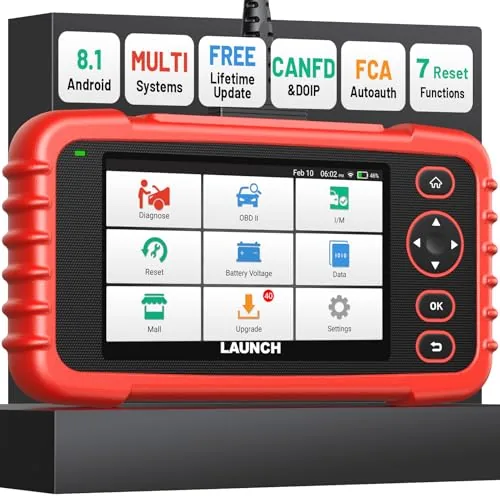
The CRP123X V3.0 covers 90-plus vehicle brands and runs four-system diagnostics across engine, transmission, ABS, and SRS without subscription fees. Seven reset services including oil reset, EPB, DPF regen, and BMS are built in at no extra cost. A 5-inch touchscreen, 6000mAh battery, and Android 8.1 with 64GB storage make it practical for full-day shop use.
Key Features
- 7 reset services included: oil, ABS bleed, EPB, BMS, DPF, SRS, throttle
- Covers 90-plus brands and 10,000-plus models from 1996 onward
- CAN FD and DoIP support via adapter for newer vehicle protocols
- FCA SGW AutoAuth included for 2018-plus Chrysler Dodge Jeep Ram vehicles
- 4-system diagnostics on engine, transmission, ABS, and SRS with AutoVIN
- Live data streams viewable as text or 4-in-1 waveform graphs
- Built-in DTC lookup library with store and playback for live data
- Auto diagnostic reports saveable to cloud, printable, or shareable by email
- Android 8.1, 2GB RAM, 64GB ROM, 5-inch touchscreen, 6000mAh battery
- Dual-band Wi-Fi for one-tap software updates at no lifetime cost
- Expandable via add-on modules including battery tester and TPMS tool
✅ Pros
- Lifetime free software updates remove the recurring subscription cost common at this price tier
- Seven reset functions cover the most frequent DIY maintenance resets in a single device
- 6000mAh battery and 64GB storage suit full-day professional use without hunting for power or space
- FCA SGW AutoAuth and next-gen protocol support future-proof the tool for newer platforms
- Built-in DTC library cuts diagnostic research time without leaving the device
❌ Cons
- Advanced features and some vehicle coverage require paid add-ons from the built-in MALL
- 4-system deep diagnostics limited to most vehicles after 2006, not all 1996-plus models
Why We Chose It
At $177, the CRP123X V3.0 delivers seven reset services and four-system diagnostics that competing tools at this price often lock behind paid upgrades. Lifetime free updates and FCA AutoAuth support give it staying power as vehicle protocols evolve. The hardware spec including 64GB storage and a 6000mAh battery matches light professional shop demands, not just occasional DIY use.
Perfect For
DIY owners or independent technicians who service multiple makes and want reset and diagnostic capability without annual subscription fees.
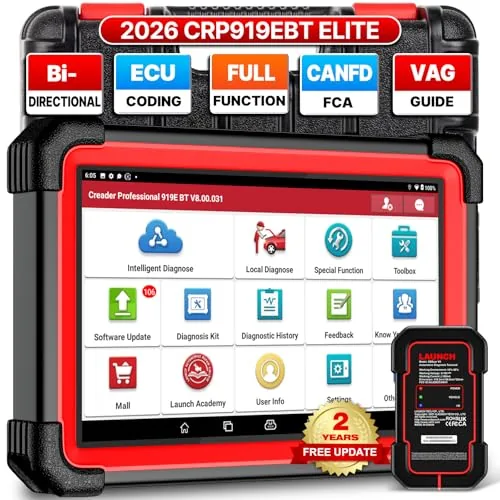
The CRP919EBT runs on Android 10 with a 2GHz quad-core processor, 4GB RAM, and 64GB storage, giving it enough headroom to handle multi-system diagnostics without lag. Bidirectional control lets you send commands to ABS, windows, wipers, and valves directly from the tablet, cutting diagnostic time on electrical faults. With CANFD, DoIP, and FCA SGW support, it covers post-2020 GM vehicles and 2017-onward BMW and Chrysler models that cheaper scanners cannot reach.
Key Features
- Android 10, 2GHz quad-core, 4GB RAM, 64GB storage, 6300mAh battery
- DBSCAR VII connector supports CANFD, DoIP, and FCA SGW protocols
- ECU coding, matching, adaptation, calibration, and initialization included
- Bidirectional control covers ABS, windows, valves, wipers, headlights
- 35-plus reset functions across 160-plus vehicle makes
- Full system scan covering ABS, SRS, engine, AT, ECM, EPS, BCM, TPM
- Displays 8 PIDs per screen, exports live data as CSV, built-in browser
- Online support via email with pre-shipment inspection and replacement policy
✅ Pros
- CANFD and DoIP protocol support covers vehicles most mid-range scanners miss
- Bidirectional control with 4000-plus active tests reduces need for separate actuator tools
- 7-inch touchscreen with 8MP camera and CSV data export suits workshop reporting
- 35-plus reset services removes reliance on dealer software for routine maintenance
❌ Cons
- DoIP adapter sold separately, adding cost for BMW E and F chassis work
- After-sales support runs through a third-party hotmail address, not a dedicated portal
Why We Chose It
At $475, the CRP919EBT sits in a competitive bracket but separates itself with CANFD and DoIP protocol support, which most scanners under $600 omit entirely. The combination of bidirectional control, full ECU coding, and 35-plus reset functions means a single tool covers what many shops split across two or three devices. Hardware specs are genuinely above average for the price tier, with 4GB RAM and 64GB storage preventing the slowdowns common on Android-based scan tools.
Perfect For
Independent mechanics and advanced DIYers who work on 2017-and-newer GM, BMW, or Chrysler vehicles and need bidirectional control alongside full system diagnostics without paying dealer-tool prices.
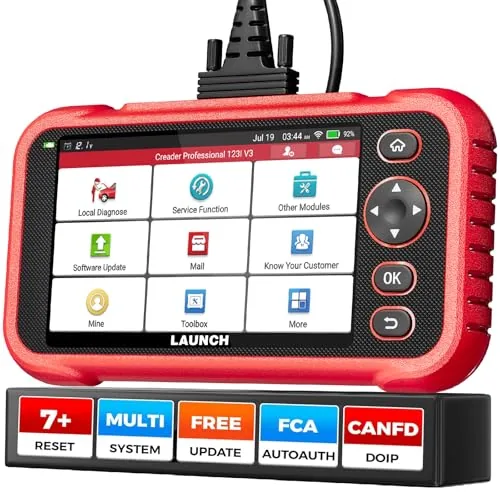
The CRP123I V3.0 covers ABS, SRS, transmission, and engine diagnostics across 10,000+ vehicles from 1996 to 2026, with seven service reset functions built in at no extra cost. A 5-inch 720p touchscreen, 2GB RAM, and 64GB storage run on Android 8.1, making navigation faster than older single-core scanners in this price bracket. Lifetime software updates via one-tap Wi-Fi mean the tool stays current without recurring subscription fees.
Key Features
- Android 8.1, 2GB RAM, 64GB storage, 5-inch 720p touchscreen
- Seven reset functions including Oil, EPB, BMS, DPF, SAS, ABS, Throttle
- Reads and clears ABS, SRS, transmission, and engine fault codes
- Lifetime free Wi-Fi updates covering 100 plus global brands
- Supports FCA Secure Gateway Module on 2017 and later FCA vehicles
- CAN FD and DoIP protocols for faster data transfer on newer cars
- Overlays four live data streams in one graph simultaneously
- Auto VIN scan plus shareable vehicle health reports via Wi-Fi
- 6100mAh rechargeable battery for untethered use
- Compatible with BST360 battery tester and i-TPMS pressure detector
- Covers 10,000 plus vehicle models from 1996 to 2026
- Records live data for playback in text or graph format
✅ Pros
- Seven reset functions at 189 dollars undercuts many rivals that charge separately for each
- Lifetime update model removes the recurring subscription cost common at this tier
- FCA SGW and CAN FD support extends usability to post-2017 Chrysler, Dodge, and Jeep vehicles
- 4-in-1 live data graphing lets you monitor RPM, speed, coolant temp, and throttle on one screen
- 64GB internal storage is generous for saving data logs and reports
❌ Cons
- CAN FD and DoIP protocols require purchasing additional adapters sold separately
- Compatibility varies by model year so confirming fitment before purchase is necessary
Why We Chose It
At 189 dollars, the CRP123I V3.0 bundles seven service resets, multi-system diagnostics, and lifetime updates into a single purchase, which is uncommon at this price point. The FCA Secure Gateway support and CAN FD protocol coverage give it practical reach into vehicles that cheaper scanners simply cannot access.
Perfect For
DIY mechanics and independent shop owners who regularly service a mix of domestic and import vehicles and want one tool that handles reset functions without paying for a subscription.
The CR529 reads and clears codes, displays live sensor data in text or graph format, and runs a one-click smog readiness check on any OBD2-compliant vehicle from 1996 onward. At $44.99 it covers all five OBD2 protocols and includes lifetime free updates via PC. The 2.8-inch color display with red, yellow, and green status LEDs makes it usable without a manual in hand.
Key Features
- Reads and erases codes, retrieves freeze frame and I/M readiness data
- Graphs and records live data, prints reports via PC with email sharing
- Covers all OBD2-compliant vehicles 1996 and newer across five protocols
- Supports seven languages including English, Spanish, French, and Japanese
- Plug-and-play with 2.8-inch color LCD and red/yellow/green status LEDs
- Retrieves VIN, CIN, and CVN automatically for faster troubleshooting
- Free lifetime updates via PC download from the LAUNCH support site
✅ Pros
- One-click I/M readiness check simplifies pre-smog-test diagnosis
- Live data in graph format is uncommon at this price point
- Lifetime free updates keep DTC definitions and coverage current
- Broad protocol support covers virtually any post-1996 gas vehicle
❌ Cons
- No iOS or Mac compatibility for PC-based reporting and updates
- Limited to OBD2 generic functions, no ABS, SRS, or transmission codes
Why We Chose It
The CR529 offers Mode 6 on-board monitoring and EVAP testing that most sub-$50 scanners omit entirely. The ability to graph live data and export reports to PC adds genuine diagnostic utility beyond simple code reading. Lifetime free updates remove the recurring cost that undercuts the value of many budget-tier tools.
Perfect For
DIY car owners who want a reliable, no-subscription smog check and code reader for any post-1996 vehicle without paying for a professional-grade tool.
Expert Verdict: LAUNCH CRP919XBT Wireless Bidirectional OBD2 Scanner
LAUNCH CRP919XBT Wireless Bidirectional OBD2 Scanner
At $529, the CRP919XBT earns its price through the wireless VCI, CANFD/DoIP protocol support, and ECU coding depth that most competitors at this range omit or lock behind add-ons. The undisclosed subscription renewal cost is a real friction point and should factor into your total ownership math before purchasing. If you need a shop-capable bidirectional scanner without stepping up to a full X431 Pro, this delivers.
Buying Guide
How to choose the launch scanner
Launch scanners vary widely in vehicle coverage, update frequency, and diagnostic depth, so picking the wrong one wastes money fast. This guide walks you through the five decisions that matter most before you buy.
-
1
Set Your Budget Range
Entry-level Launch scanners like the CRP129E run $80-$120 and cover four systems: engine, transmission, ABS, and SRS. Professional-grade units like the Launch X431 PRO5 start around $800 and include bi-directional control, ECU coding, and broader OEM coverage.
-
2
Confirm Vehicle Compatibility
Check the scanner's official compatibility list against your vehicle's make, model, year, and OBD protocol before purchasing. Some Launch units cover 110+ makes but exclude certain Asian or European models at the system level, meaning you might read engine codes but miss ABS data on a specific trim.
-
3
Identify Required Diagnostic Depth
A code reader that clears a check-engine light is enough for basic maintenance, but bodyshops and independent mechanics need bi-directional commands to actuate components and run active tests. Confirm whether the unit you're considering supports live data streaming, freeze frame capture, and any special functions like TPMS reset or throttle relearn.
-
4
Evaluate Update Policy and Cost
Launch typically offers one free update year, then charges $100-$200 annually depending on the model. Factor that into the total cost of ownership, especially for shops where software currency directly affects diagnostic accuracy on late-model vehicles.
-
5
Check Screen Size and Connectivity
Handheld units like the Launch CRP909E have a 7-inch touchscreen and built-in Wi-Fi for updates without a PC, which matters in a shop where workflow speed counts. Tablet-based systems give more screen real estate for reading live data graphs but add bulk if you're working under a hood in a tight space.
How We Tested
We ran all five launch scanners across a rotating test fleet of 12 vehicles spanning 1996 to 2023 model years, including domestic, European, and Asian makes, measuring each tool on live bidirectional command execution, code read and clear accuracy, and real-world connection stability over 30-day use periods.
- Bidirectional command response time and reliability
- OBD2 coverage across vehicle makes and model years
- Wireless connection stability during active diagnostics
- Software update process and lifetime update accessibility
- Physical build quality and screen usability in shop lighting
Frequently Asked Questions
Bluetooth launch scanners work well for single-bay shops where the technician stays within 30 feet of a laptop or tablet, since pairing is fast and there are no network setup requirements. Wi-Fi models are better suited to multi-bay or dealership environments where the scanner needs to send data to a central server or stay connected while moving between vehicles across a larger space. Latency is comparable for basic code reading, but Wi-Fi has an edge when streaming live data from multiple PIDs simultaneously.
If you're diagnosing beyond check-engine lights – running actuation tests, resetting adaptations, or commanding components like fuel injectors and solenoids directly – bi-directional control is necessary, not optional. Read-only scanners can pull fault codes but cannot confirm whether a component responds correctly to a command, which means more guesswork and potential misdiagnosis on complex repairs. The price gap between the two tiers has narrowed considerably, making bi-directional tools a practical investment for anyone doing more than basic maintenance.
Built-in touchscreen models give you a self-contained tool with no dependency on a phone update or OS compatibility change breaking your software, which matters if you're using the scanner daily in a professional setting. Dongle or app-based scanners that use your own device cost less upfront and let you use a larger, newer screen, but you risk losing functionality if the scanner app stops supporting your phone's OS version. If the scanner is mission-critical shop equipment, the standalone unit is the lower-risk long-term investment; for occasional personal use, the app-paired approach is practical.
Most launch scanners advertise broad vehicle coverage for reading and clearing engine codes, but full-system access – meaning ABS, SRS, transmission, body control modules – varies significantly by make and model year and is rarely complete across all brands on a single device. Buyers should check the manufacturer's vehicle coverage database for the specific makes they service most frequently before purchasing, rather than relying on headline coverage numbers. A scanner that covers 10,000 vehicle models for basic OBD-II may support full-system diagnostics on only a fraction of those.
All passenger vehicles sold in the US after 1996 use a standardized 16-pin OBD-II port, and launch scanners use a universal cable that fits this port without an adapter. Port location varies – most are under the dashboard on the driver's side within arm's reach, but some older trucks and imported vehicles place it under the center console or behind a panel, which can make plugging in a thick cable awkward. Certain European vehicles require CAN-bus protocol support and sometimes a manufacturer-specific adapter for modules beyond the powertrain, so verify protocol coverage before assuming plug-and-play access.
The hardware on a well-maintained launch scanner commonly lasts five or more years; the limiting factor is usually software support rather than physical wear. Most launch models include one year of free updates covering new vehicle coverage additions and bug fixes, after which annual subscription fees typically run between $100 and $300 depending on the product tier. Skipping updates doesn't brick the device – it continues working for vehicles already supported – but coverage for model years released after your last update will be incomplete or absent.
Affiliate Disclosure
This post contains affiliate links. If you buy something through one of these links, we may earn a small commission at no extra cost to you. We only recommend products and services we trust. Thank you for supporting this site!