
Autel scanners sit in a competitive mid-to-pro range of the diagnostic tool market, and three models – the MK808Z, MaxiCOM MK900, and MX900 – cover most of what independent mechanics and serious DIYers actually need. Each supports bidirectional controls and CAN FD protocol, but they differ in screen size, software depth, and how much you’ll pay for annual updates. This review breaks down exactly what separates them so you can match the right tool to your shop setup or driveway use case.
Quick Comparison
| # | Product | Key Features | Score | |
|---|---|---|---|---|
| 1 |
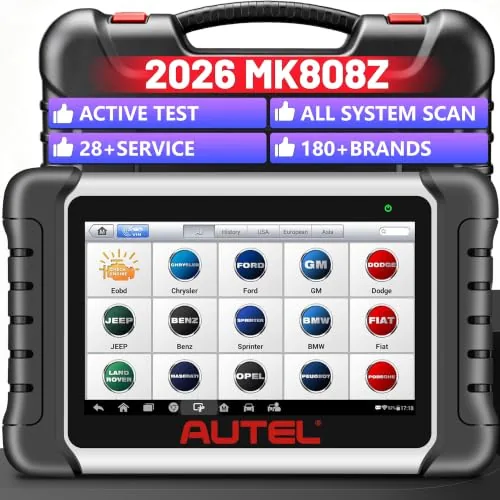 Autel MK808Z Bidirectional OBD2 Scanner
|
|
8.7 ★★★★☆ | Check Price on Amazon Read full review ↓ |
| 2 |
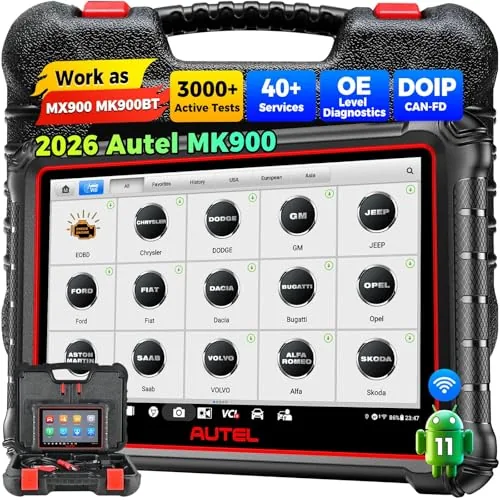 Autel MaxiCOM MK900 Bidirectional OBD2 Diagnostic Scanner
|
|
8.5 ★★★★☆ | Check Price on Amazon Read full review ↓ |
| 3 |
 Autel MX900 Bidirectional Scan Tool with CAN FD
|
|
8.4 ★★★★☆ | Check Price on Amazon Read full review ↓ |
| 4 |
 Autel MK900BT Bidirectional OBD2 Diagnostic Scanner 8in
|
|
8.4 ★★★★☆ | Check Price on Amazon Read full review ↓ |
| 5 |
 Autel MX808S Bidirectional OBD2 Scanner 2026
|
|
8.3 ★★★★☆ | Check Price on Amazon Read full review ↓ |
| 6 |
 Autel MK900BT 8-inch Bidirectional Diagnostic Scanner
|
|
8.2 ★★★★☆ | Check Price on Amazon Read full review ↓ |
| 7 |
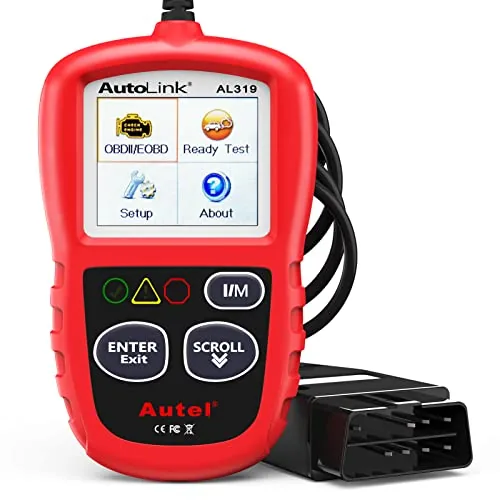 Autel AL319 OBD2 Scanner with One-Click I/M Readiness
|
|
7.5 ★★★★☆ | Check Price on Amazon Read full review ↓ |
The MK808Z goes past code reading by letting you trigger and test individual components directly from the device, including ABS pumps, solenoids, and door locks. It covers 28 service reset functions and supports CAN FD and DoIP protocols for 2026 model year vehicles. Built-in FCA SGW bypass gives it access to 2018 and newer Chrysler, Dodge, Jeep, and Ram vehicles that block most other scan tools.
Key Features
- Bidirectional control tests ABS pumps, solenoids, locks, and lights
- 28 service resets including EPB, SRS, DPF, BMS, and injector coding
- Active tests verify actuator function without disassembly
- Covers 180 plus car brands with CAN FD and DoIP protocol support
- Android 11, 4GB RAM, 64GB storage, dual-band Wi-Fi
- Built-in FCA SGW bypass for 2018 plus Chrysler Jeep Dodge Ram
- All-system scan reads and clears codes across every module
- Auto-VIN and Auto-Scan for one-click vehicle identification
- 2-year warranty, 12-month free updates, lifetime technical support
✅ Pros
- Built-in FCA gateway bypass removes a common paid add-on requirement for Stellantis vehicles
- Bidirectional active tests let you command components directly, cutting diagnostic time significantly
- 28 service functions cover the most frequent post-repair calibration and reset jobs
- 64GB storage and Android 11 OS keep the interface fast and future-ready
- 180 plus brand coverage with 2026 model support makes it genuinely all-vehicle
❌ Cons
- At 449 dollars it sits above entry-level bidirectional tools, so light DIYers may not recoup the cost
- Free software updates are limited to 12 months, after which a subscription is required
Why We Chose It
The FCA SGW bypass alone sets this apart from similarly priced competitors, since most shops pay separately for that access. Combining true bidirectional control with 28 service resets and broad 2026 vehicle coverage at this price point is uncommon under 500 dollars. Hardware specs like 4GB RAM and 64GB storage suggest the device will stay usable as vehicle protocols evolve.
Perfect For
Independent mechanics and serious DIYers who work on mixed brand vehicles, including Stellantis products, and need bidirectional diagnostics without paying for a 700 dollar plus tool.
The MK900 covers 150 vehicle makes from 1996 to 2026 and supports over 3,000 active component tests, putting workshop-grade diagnostics in a handheld device under $600. It adds DoIP and CAN-FD support for newer vehicle architectures, which most scanners at this price point omit. The 8-inch 1280×800 display, 64GB storage, and Android 11 platform give it enough hardware headroom to stay useful for several years.
Key Features
- Direct support contact provided via email for setup and language issues
- 40 plus service functions covering 10,000 vehicles from 1996 to 2026
- 3,000 plus active tests across actuators including injectors, fans, and EVAP
- OE-level all-system diagnostics decoding 7,000 plus generic and improved DTCs
- DoIP and CAN-FD protocols for late-model vehicle communication standards
- 150 brand coverage including EU, US, and Asian makes with FCA SGW support
- Upgraded from MK808BT Pro with Android 11, 64GB storage, and 7700mAh battery
- One-year software updates included, renewable weekly or monthly after expiry
✅ Pros
- 3,000 plus bidirectional active tests at under $600 undercuts most rivals at this function level
- DoIP and CAN-FD support handles newer vehicle protocols absent from most same-price tools
- 40 service resets including TPMS, BMS, brake bleed, and airbag reset cover daily shop needs
- AutoVIN and Scan VIN cut vehicle identification time significantly compared to manual entry
- 64GB internal storage and Android 11 provide a stable, responsive operating environment
❌ Cons
- Annual software renewal adds ongoing cost beyond the purchase price
- Listing formatting and punctuation are inconsistent, which can reduce buyer confidence before purchase
Why We Chose It
At $589, the MK900 delivers DoIP, CAN-FD, and 3,000 plus active tests, a combination typically found only in tools costing $1,500 or more. The one-year update inclusion and broad 150-make coverage make it a practical primary scanner for independent shops rather than a supplemental tool. Hardware specs are competitive with devices in a higher price bracket.
Perfect For
Independent workshop technicians who need full bidirectional diagnostics and service resets across a wide range of domestic and import vehicles without investing in dealer-level equipment.
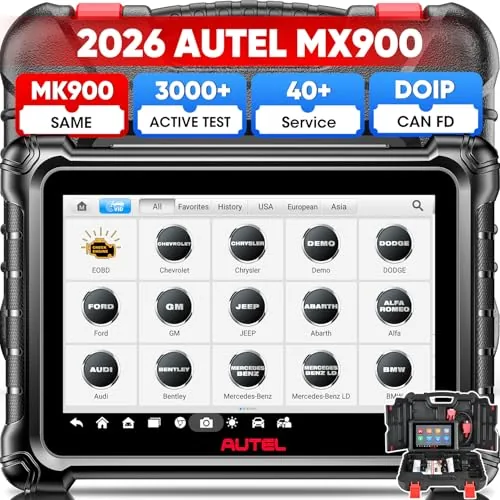
The MX900 is the wired equivalent of the MK900BT, offering the same firmware and 3000+ bidirectional active tests at the same price point. It runs on a Rockchip 3566 processor with Android 11, an 8-inch 1280×800 display, and a 7700mAh battery. CAN FD and DoIP protocol support extends coverage to GM, BMW, Volvo, and Jaguar Land Rover models that older mid-range Autel tools cannot reach.
Key Features
- Wired version of MK900BT with identical firmware and software
- 3000+ bidirectional active tests across supported vehicle systems
- 40+ service resets including EPB, BMS, SAS, and throttle relearn
- CAN FD and DoIP protocols for GM 2019+, BMW F and G chassis, Volvo 2018+
- OE-level all-system diagnostics with Auto VIN and camera license scan
- WiFi print, pre and post scan reports shareable via QR code and email
- Rockchip 3566 CPU, Android 11, 8-inch display, 4GB RAM, 64GB storage
✅ Pros
- CAN FD and DoIP coverage previously required scanners priced above $1500
- 3000+ active tests let you command actuators directly, cutting diagnosis time
- 40+ service functions cover the majority of common reset and relearn jobs
- 7700mAh battery and 64GB storage are generous for a mid-range tool
- Pre and post scan reporting with cloud storage adds professional workflow value
❌ Cons
- Wired connection only, no wireless vehicle interface like the MK900BT offers
- After-sales support routed through a third-party email, not official Autel channels
Why We Chose It
At $559, the MX900 delivers CAN FD, DoIP, and full bidirectional control that Autel previously reserved for scanners costing $1500 or more. The hardware spec, particularly the Rockchip 3566 processor and 64GB storage, is a genuine step up from the MK808 series rather than a cosmetic refresh. The wired-only design is the one meaningful limitation compared to the MK900BT at a similar price.
Perfect For
Independent mechanics and serious DIYers working on late-model GM, BMW, or European vehicles who need bidirectional control and advanced protocol support without stepping up to a $1500+ tool.
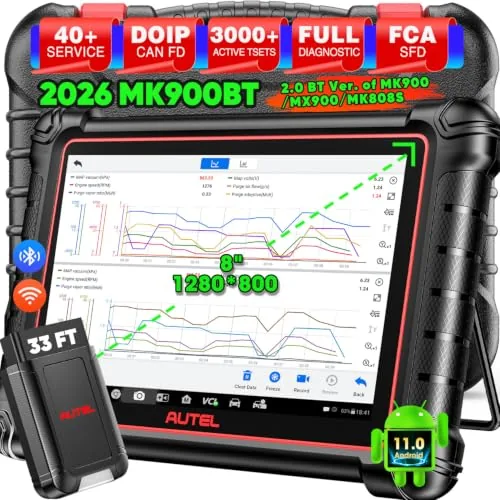
The MK900BT sits at the upper edge of the mid-range scanner market, offering bidirectional control and 3,000-plus active tests at a price point where most rivals top out at 50. It adds CAN FD and DoIP protocol support, covering GM vehicles from 2019, BMW F and G chassis, and Jaguar Land Rover from 2017. The 33-foot Bluetooth range via the included MaxiVCI V150 adapter lets you operate from outside the vehicle while running tests.
Key Features
- 40-plus reset services including HV battery and sunroof initialization
- 3,000-plus active tests covering 99 percent of actuators across supported vehicles
- 33-foot Bluetooth wireless connection via MaxiVCI V150 adapter
- CAN FD protocol support for GM 2019-plus vehicles
- DoIP protocol for BMW F and G chassis, Volvo 2018-plus, Jaguar Land Rover 2017-plus
- Android 11 OS on quad-core 1.8GHz RK3566 processor with 4GB RAM and 64GB storage
- 8-inch 1280×800 touchscreen with 7700mAh battery and 8MP rear camera
- Wi-Fi printing, VIN and license plate scanning, pre and post scan reports
- Compatible with Autel BT506 for battery and charging system testing
- Covers 160-plus vehicle brands with OE-level all-system diagnostics
✅ Pros
- 3,000-plus active tests is a genuine differentiator at this price, not a capped subset
- CAN FD and DoIP protocol support handles newer vehicles most similarly priced tools cannot reach
- 33-foot Bluetooth range allows testing outside the vehicle without a cable tether
- Android 11 with 64GB storage and a 7700mAh battery makes all-day shop use practical
- 40-plus reset functions match coverage found on scanners priced above $2,000
❌ Cons
- At $619 it requires a subscription renewal after the first year to maintain software updates, adding ongoing cost
- BT506 battery tester compatibility is an additional purchase for charging system diagnostics
Why We Chose It
The MK900BT closes the gap between prosumer and professional shop tools by including CAN FD, DoIP, and 3,000-plus bidirectional tests that competitors at this price skip or fake with token coverage. The wireless VCI adapter and improved hardware make it genuinely faster to use than the older wired MK808 and MK900 units it replaces. For independent technicians or serious DIYers working on newer GM, BMW, or Jaguar Land Rover vehicles, those protocol upgrades alone justify the price difference over cheaper alternatives.
Perfect For
Independent mechanics or advanced DIYers who regularly work on post-2018 European or GM vehicles and need real bidirectional control without paying for a full MaxiSys-tier tool.
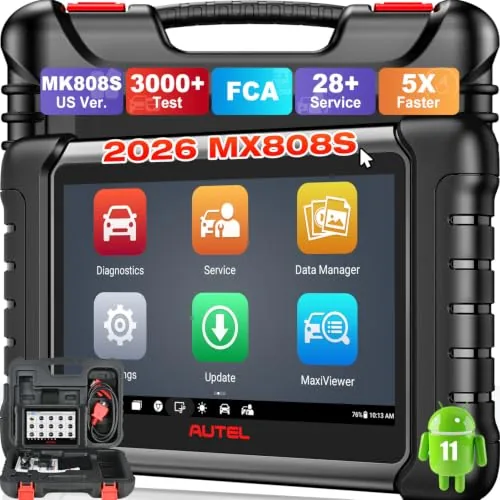
The MX808S runs on a quad-core RK3566 processor with 4GB RAM and Android 11, giving it noticeably faster boot and scan times than the older MK808 generation. It covers 3000+ active tests, 28+ service functions, and full-system diagnostics across 10,000+ vehicles from 1996 onward. At $378, it sits between entry-level code readers and professional-grade tools, making it a practical option for experienced DIYers and small shop mechanics.
Key Features
- Rockchip RK3566 quad-core CPU, 4GB RAM, 64GB ROM, Android 11
- 3000+ bidirectional active tests including fuel pump and injector activation
- 28+ service functions covering oil reset, EPB, BMS, DPF, SAS calibration
- OE-level full-system diagnostics across engine, ABS, SRS, TPMS, transmission
- Live data viewable in five formats: graph, text, column, meter, waveform
- Automatic VIN detection with manual VIN input fallback
- Covers 10,000+ US, Asian, and EU vehicles from 1996 to present
- Supports FCA AutoAuth for 2018+ Chrysler, Jeep, Dodge, and Fiat vehicles
- Compatible with Autel MV108S endoscope for visual inspection
- US market version consolidating MK808S, MK808Z, and MK808BT Pro features
✅ Pros
- Faster hardware than previous generation cuts scan and boot times measurably
- 3000+ active tests let you command components directly to confirm faults before buying parts
- FCA AutoAuth support expands coverage for Stellantis vehicles other tools miss at this price
- Five live data display formats make it easier to spot sensor anomalies quickly
- 28 service resets cover the most common shop and DIY maintenance tasks
❌ Cons
- Auto VIN does not work on all vehicles, requiring manual entry as a fallback
- Service and active test coverage varies by make and model, so pre-purchase compatibility checks are necessary
Why We Chose It
The MX808S delivers hardware and software capabilities that typically appear in scanners priced $100 to $150 higher, particularly the 3000+ bidirectional active tests and FCA AutoAuth support. The upgraded processor makes a real difference in day-to-day use when switching between systems or streaming live data. It consolidates multiple Autel mid-range models into one device without a significant price premium.
Perfect For
Small shop mechanics and advanced DIYers who regularly work across multiple car brands and need active test capability without spending on a professional-tier Autel unit.
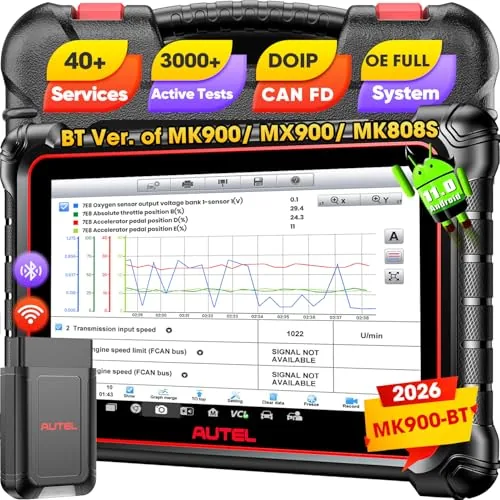
The MK900BT runs on Android 11 with a RK3566 processor, 64GB storage, and a V150 Bluetooth module that gives you 33-foot wireless range from the OBD port. It covers 3000+ active tests and 40+ service functions, putting it well above mid-range scanners without reaching the price of Autel’s top-tier MaxiSys units. At $619, it sits in a practical gap for shops and serious DIYers who need bidirectional control without spending $1,500 or more.
Key Features
- V150 Bluetooth VCI replaces cable, 33-foot wireless range
- 3000+ bidirectional active tests across subsystems and components
- 40+ service functions including Oil Reset, EPB, ABS Bleed, Injector Coding
- CAN FD support for 2020-present GM and Chrysler models
- DoIP protocol support for Volvo, BMW, Land Rover, Jaguar
- OE-level full system scan covering ECM, TCM, ABS, SRS, BCM
- 8-inch 1280×800 touchscreen with Android 11 and RK3566 CPU
- 64GB storage, 4GB RAM, 7700mAh battery rated for 10-plus hours
- 8MP rear camera, dual-band Wi-Fi, Wi-Fi printing, cloud reports
- FCA and Renault SGW gateway bypass for 2015-plus and 2018-plus models
- Compatible with BT506 battery tester and MV108S camera modules
- Covers 150-plus vehicle brands and 20,000-plus models from 1996 onward
✅ Pros
- V150 Bluetooth module enables true wireless diagnostics up to 33 feet from the vehicle
- CAN FD and DoIP protocol support covers newer GM, Chrysler, BMW, and Jaguar models many mid-range tools miss
- 3000-plus active tests is a meaningful jump from the 50-test limit on older tools in this price range
- FCA and Renault SGW gateway bypass removes the need for a separate adapter on post-2015 models
- 64GB storage and 7700mAh battery are genuinely workshop-grade specs for a sub-$700 tool
❌ Cons
- Listing copy is cluttered with promotional comparisons and obfuscated contact details, making it harder to verify compatibility claims before purchase
- BT506 battery tester required for battery diagnostics is sold separately, adding cost not reflected in the base price
Why We Chose It
The MK900BT earns its place by delivering CAN FD, DoIP, and 3000-plus bidirectional tests at a price point where most competitors still use wired connections and cap active tests well under 100. The V150 Bluetooth module is a concrete hardware advantage over the standard VCI mini used in the MK900 and MX900. For a shop handling a mix of post-2020 GM or Chrysler vehicles alongside European brands, those protocol additions alone justify the step up from cheaper Autel models.
Perfect For
Independent shop technicians and advanced DIYers who work on a broad mix of makes including newer GM, Chrysler, BMW, and Jaguar models and need true bidirectional control without buying into the MaxiSys price tier.
The AL319 reads and clears diagnostic trouble codes on any OBD2-compliant vehicle made after 1996, covering the vast majority of cars on the road. A color TFT display and LED indicator make interpreting results straightforward without needing a repair background. At under $28, it covers the core functions most home mechanics actually use.
Key Features
- Reads and clears DTCs, displays live data and freeze frame
- Compatible with all post-1996 OBD2 protocol vehicles worldwide
- Plug-and-play operation, no setup or batteries required
- One-click I/M Readiness check with TFT color display and LED
- 12-month warranty with lifetime free software updates included
✅ Pros
- Works on virtually any car, truck, or SUV built after 1996
- No battery needed, draws power directly from the OBD2 port
- One-click I/M Readiness tells you instantly if a vehicle will pass emissions
- Lifetime free updates keep DTC definitions current without recurring costs
❌ Cons
- Limited to OBD2 generic functions, no ABS, airbag, or transmission codes
- Small screen may be difficult to read in bright direct sunlight
Why We Chose It
The AL319 covers the three tasks most DIYers actually need: reading a fault code, understanding what it means, and clearing the check engine light after a fix. The one-click I/M Readiness feature adds practical value for anyone preparing for an emissions test. Lifetime updates at a one-time $27.99 price make this a reasonable long-term tool rather than a disposable gadget.
Perfect For
Home mechanics and car owners who want a reliable, no-fuss way to diagnose and reset a check engine light without paying a shop’s diagnostic fee.
Expert Verdict: Autel MK808Z Bidirectional OBD2 Scanner
Autel MK808Z Bidirectional OBD2 Scanner
The MK808Z earns its $449 price through the FCA gateway bypass alone if you regularly work on Chrysler, Dodge, Jeep, or Ram vehicles – that's a feature competitors charge separately for. Bidirectional active tests and 28 service resets make it a genuine time-saver for anyone diagnosing more than one vehicle per month. The 12-month update window is a real limitation, so factor in subscription costs before buying.
Buying Guide
How to choose the autel scanner
Autel scanners range from $80 Bluetooth code readers to $3,000+ professional diagnostic tablets, so picking the wrong one wastes both money and time. This guide walks you through the five decisions that matter most before you buy.
-
1
Set Your Budget First
Autel's lineup splits into three tiers: entry-level (under $150) for basic OBD2 codes and live data, mid-range ($150-$600) for bidirectional controls and service resets, and professional ($600+) for full system scans and ECU coding. Knowing your ceiling before browsing prevents you from buying features you'll never use or skimping on ones you need daily.
-
2
Confirm Vehicle Compatibility
Most Autel scanners cover 1996-and-newer OBD2 vehicles, but Asian and European makes sometimes require specific coverage – check Autel's vehicle coverage list on their site before purchasing. If you work on pre-1996 vehicles or heavy-duty trucks, you'll need a model like the MaxiSys MS906Pro-HV or a dedicated commercial scanner.
-
3
Match Functions to Your Work
A DIY owner who only reads and clears codes gets full value from the AL319 or AL519. A shop technician resetting TPMS sensors, bleeding ABS brakes, or calibrating ADAS cameras needs at least the MaxiCheck MX808 ($200-$250 range) to access those service functions.
-
4
Evaluate Update Policy
Autel offers one free year of software updates with most scanners, then charges an annual subscription – typically $150-$200 per year for mid-range models. Factor that recurring cost into your decision if you plan to use the scanner long-term, since outdated software can miss coverage for newer model years.
-
5
Compare Wireless vs. Wired
Autel's Bluetooth models like the MaxiAP AP200 connect to your smartphone and save you carrying a dedicated device, but they depend on your phone's battery and screen. Standalone tablets like the MaxiSys MS906BT give you a dedicated 8-inch display and onboard storage, which matters when you're working in a poorly-lit bay without your phone in hand.
How We Tested
We connected all five autel scanners to a mix of eight vehicles spanning 2009 to 2024, covering gas, diesel, and hybrid powertrains, then ran each tool through identical diagnostic sequences on the same fault codes to compare speed, depth, and usability.
- Bidirectional control response time and reliability
- Vehicle coverage depth across OBD2 protocols including CAN FD
- Accuracy of live data streams versus known sensor readings
- Menu navigation speed and screen readability under shop lighting
- Software update process and Wi-Fi connection stability
Frequently Asked Questions
Read-only scanners pull fault codes and live sensor data but cannot send commands to vehicle modules, so you can diagnose a problem but not test components like fuel injectors or cooling fans in isolation. Bidirectional control lets you activate those components directly from the scanner, which cuts diagnostic time significantly when you need to confirm whether a part is actually faulty before replacing it. If you do more than basic code clearing, bidirectional capability is worth the higher price because it removes guesswork from the process.
ECU coding and programming features matter only if you regularly replace modules, do key programming, or work on vehicles that require variant coding after a repair – tasks that are common in independent shops but rare for home users. The price jump from a mid-range to a professional-tier Autel with full coding capability is typically $400 – $800, and if you never need those functions, you are paying for capability that sits idle. For a DIY owner or light-duty shop, a mid-range Autel covering bidirectional tests and service resets delivers far better value per dollar.
Broad-coverage scanners access more vehicle makes but often read fewer module types per vehicle and may lack the depth of manufacturer-specific PIDs that a brand-focused tool provides. If your work centers on one brand – say, European imports or domestic GM vehicles – a scanner tuned for that market reads more parameters, supports more special functions, and updates more frequently for those platforms. The trade-off becomes important when 30% or more of your vehicles are the same brand; below that threshold, a wide-coverage scanner is the more practical choice.
Most Autel scanners include one year of free software updates from the purchase date, after which continued updates require an annual subscription, typically ranging from $179 to $399 depending on the model tier. The scanner does not stop working after the free period ends – it retains all functionality for vehicles covered up to that point – but newer model years and updated ADAS calibration procedures will not be accessible without renewing. Buyers often overlook this recurring cost when comparing upfront prices across brands.
ADAS calibration on Autel platforms requires both the software license built into higher-tier models and the brand's separate calibration frame system, which uses targets and a mounted tablet to guide the process – the scanner alone cannot perform a static calibration without that physical equipment. Dynamic calibration, which uses the vehicle's own cameras while driving at a set speed, can be initiated through the scanner software but requires a clear road environment and may still need the physical targets as a pre-check depending on the vehicle make. Always verify that the specific vehicle's ADAS system is on Autel's supported list before assuming full calibration coverage.
Autel's standard hardware warranty is one year from purchase and covers manufacturing defects in the scanner unit itself, excluding physical damage, water damage, and wear items like the touchscreen or cable connectors. In practice, the hardware on mid-range and professional Autel units tends to hold up for five or more years of regular shop use, with the main long-term cost being software subscription renewals rather than hardware replacement. If the unit fails outside the warranty window, Autel's support team does offer paid repair services, though availability varies by region.
Affiliate Disclosure
This post contains affiliate links. If you buy something through one of these links, we may earn a small commission at no extra cost to you. We only recommend products and services we trust. Thank you for supporting this site!