
Most generic OBD2 scanners read engine codes on a Mercedes and stop there, leaving ABS, SRS, transmission, and module-specific faults completely invisible. Mercedes vehicles use proprietary protocols and manufacturer-specific codes that require a scanner built to handle them. This review covers three tools – the OBDMATE OM807, iCarsoft MB II, and Foxwell NT301 – ranked by how well they actually serve Mercedes owners, from DIY troubleshooting to pre-purchase inspections.
Quick Comparison
| # | Product | Key Features | Score | |
|---|---|---|---|---|
| 1 |
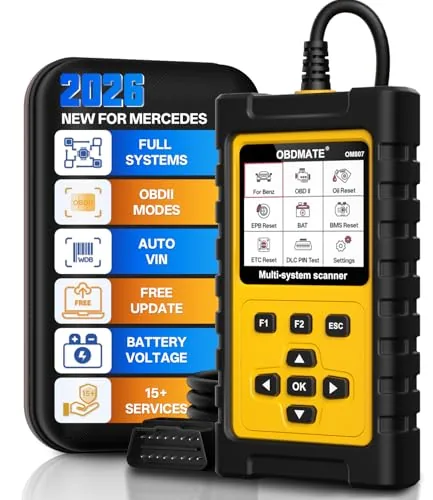 OBDMATE OM807 Mercedes-Benz Full System OBD2 Scanner
|
|
8.2 ★★★★☆ | Check Price on Amazon Read full review ↓ |
| 2 |
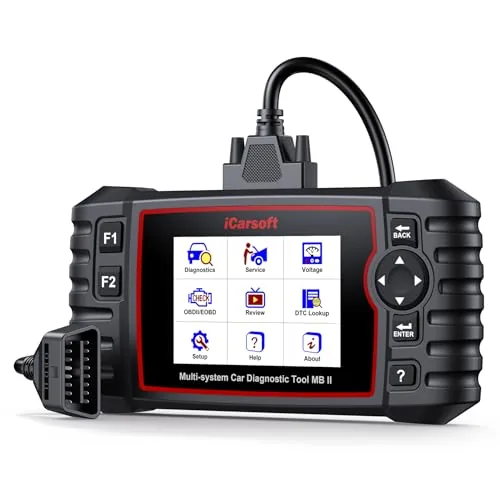 iCarsoft MB II Mercedes Multi-System Diagnostic Scanner
|
|
8.2 ★★★★☆ | Check Price on Amazon Read full review ↓ |
| 3 |
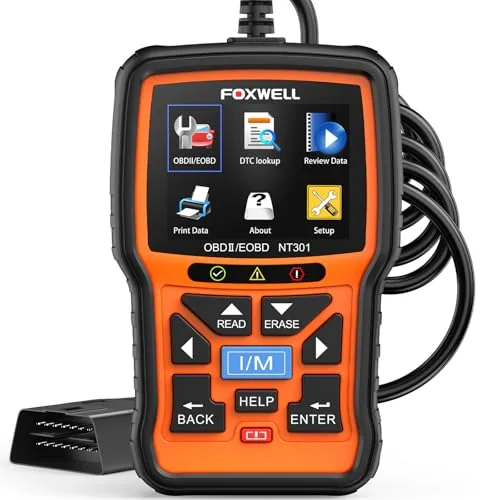 Foxwell NT301 OBD2 Scanner with Live Data Graphing
|
|
8.2 ★★★★☆ | Check Price on Amazon Read full review ↓ |
| 4 |
 iCarsoft MB V2.0 Mercedes Multi-System Diagnostic Scanner
|
|
8.2 ★★★★☆ | Check Price on Amazon Read full review ↓ |
| 5 |
 ANCEL AD310 OBD II Scanner with Full Protocol Support
|
|
7.8 ★★★★☆ | Check Price on Amazon Read full review ↓ |
| 6 |
 ANCEL AD410 OBD2 Scanner with 42,000+ DTC Database
|
|
7.8 ★★★★☆ | Check Price on Amazon Read full review ↓ |
| 7 |
 MOTOPOWER MP69033 OBD2 Code Reader Scanner Yellow
|
|
7.2 ★★★★☆ | Check Price on Amazon Read full review ↓ |
| 8 |
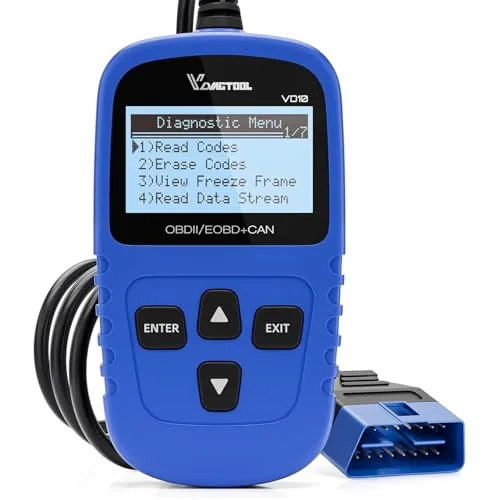 VDIAGTOOL VD10 OBD2 Scanner with Live Data and I/M Readiness
|
|
7.2 ★★★★☆ | Check Price on Amazon Read full review ↓ |
The OM807 targets Mercedes-Benz owners who want dealership-level diagnostics without the dealership bill. It covers all major vehicle systems from ABS to transmission and includes 15 Mercedes-specific reset functions like oil reset, EPB, SAS, and AdBlue. Lifetime free software updates via WiFi or USB keep it current without ongoing subscription costs.
Key Features
- Covers most Mercedes-Benz vehicles from 2000 to 2021
- Full system diagnostics including ABS, SRS, engine, and transmission
- 15 Mercedes-specific reset services for common maintenance tasks
- Diesel vehicle support for DPF regeneration and AdBlue reset
- Universal OBD2 functions compatible with all 1996 and newer vehicles
- Lifetime free software updates via WiFi or USB connection
- 2.8-inch color screen with automatic VIN recognition and plug-and-play setup
- Seven language options including English, German, French, and Spanish
✅ Pros
- 15 Mercedes-specific resets cover oil, EPB, battery, SAS, TPMS, and AdBlue without a shop visit
- Lifetime free updates with no subscription fee is a genuine long-term cost advantage
- Works as a universal OBD2 reader on non-Mercedes vehicles too
- Diesel-specific functions like DPF regeneration and AdBlue reset are rare at this price point
❌ Cons
- Feature availability varies by vehicle year and model, requiring compatibility verification before purchase
- 2.8-inch screen is functional but small for extended diagnostic sessions
Why We Chose It
At $132.99, the OM807 delivers reset and diagnostic capabilities that typically require either a dealer visit or a much more expensive tool. The combination of Mercedes-specific resets, full system scanning, and no-subscription lifetime updates makes the per-use cost low for anyone maintaining one Mercedes long-term. Diesel support including AdBlue and DPF functions adds meaningful value for owners of Mercedes diesel models.
Perfect For
Mercedes-Benz owners who perform their own maintenance and want to avoid dealer diagnostic fees for routine resets and fault code work.
The MB II reads and clears fault codes across engine, transmission, ABS, and airbag systems on Mercedes-Benz vehicles, going well beyond a generic OBD2 reader. It also handles EPB, steering angle sensor, and electronic throttle resets, which are jobs that usually require a dealer visit or expensive workshop tool. At $142, it covers an unusually wide range of Mercedes chassis codes spanning decades of models.
Key Features
- Reads and clears DTCs on engine, transmission, ABS, and airbag systems
- EPB, SAS, and ETC service resets supported
- OBD II and EOBD compliant, turns off Check Engine Light
- Supports chassis codes from 118 to 905 series and MB100
✅ Pros
- Covers Mercedes-specific systems that generic OBD2 tools cannot access
- EPB and SAS reset capability eliminates common dealer-only service visits
- Wide chassis support spans older W124 and W140 models through current platforms
- One-brand focus means deeper system coverage than multi-brand alternatives
❌ Cons
- Works only on Mercedes-Benz, so useless if you own other makes
- No mention of software update policy or update cost after purchase
Why We Chose It
The MB II targets Mercedes owners who want dealer-level diagnostic access without the dealer bill. The combination of multi-system fault code reading with EPB, SAS, and ETC resets at this price point is hard to match with a generic scan tool.
Perfect For
Mercedes-Benz owners or independent mechanics who regularly service one or more MB vehicles and want to handle brake pad resets and steering calibration without a dealer visit.
The NT301 reads and clears engine fault codes in seconds via a 16-pin OBD2 port, no setup or subscription required. A 2.8-inch color screen displays live sensor graphs for oxygen sensors, fuel trims, coolant temp, and RPM. At $55.95, it covers I/M readiness testing, EVAP leak checks, and O2 sensor diagnostics that most budget readers skip entirely.
Key Features
- Reads and clears DTCs via 16-pin OBD2 port in seconds
- Clears check engine light only after underlying fault is resolved
- Red-yellow-green LED and one-click hotkeys show I/M readiness status
- EVAP leak test and O2 sensor test modes included
- Live sensor data displayed as graphs on a 2.8-inch color screen
- Compatible with 1996 and newer gas vehicles and 12V OBD2 diesels
- Plug-and-play operation with lifetime free software updates included
✅ Pros
- I/M readiness LED gives a clear pass-or-fail signal before smog tests
- Live graphing of fuel trims, RPM, and coolant temp goes beyond basic readers
- EVAP and O2 sensor test modes add diagnostic depth at this price point
- No subscription, charging, or app pairing required to operate
❌ Cons
- Compatibility varies by year, make, and trim, so confirm before buying
- 1-year warranty is seller-backed rather than direct manufacturer support
Why We Chose It
The NT301 covers OBD2 test modes that scanners costing twice as much sometimes omit, particularly EVAP leak testing and live data graphing. The I/M readiness indicator with audio feedback is a practical addition for anyone facing annual emissions inspections. Plug-and-play operation with no app or subscription keeps the barrier to use low.
Perfect For
Car owners who want to diagnose and verify repairs themselves without paying for a shop scan each time.
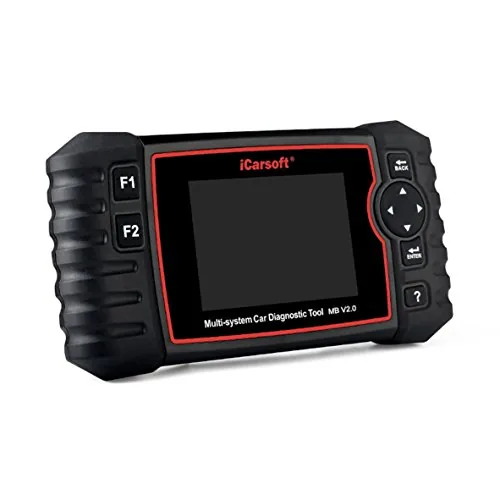
The MB V2.0 covers all major Mercedes systems including engine, transmission, ABS, and airbag modules from a single tool. It also handles service resets for oil, EPB, steering angle sensor, and throttle control. Older pre-OBD2 chassis like the W210 and W140 are supported with separate 38-pin adapters sold separately.
Key Features
- Reads and clears codes across engine, transmission, ABS, and airbag systems
- Supports OBD2 and EOBD ten-mode full ECU diagnosis
- Prints diagnostic data and custom test reports
- Older chassis 202, 210, 140, 208, 170, 129 need separate 38-pin adapters
- Resets oil service light, EPB, SAS calibration, and throttle control
✅ Pros
- Covers full system diagnosis not just engine codes
- Service reset functions for EPB and steering angle sensor add real shop value
- Older W140 and W210 chassis support sets it apart from generic OBD2 readers
- Print function useful for documenting repairs or sharing with a mechanic
❌ Cons
- 38-pin adapters for pre-OBD2 chassis sold separately adding to total cost
- No mention of software update policy or update fees
Why We Chose It
The MB V2.0 goes beyond basic code reading by covering ABS, airbag, transmission, and four service calibration functions in one unit. Support for older non-OBD2 Mercedes chassis makes it more versatile than most single-brand scanners at this price point. At $145.95 it sits between a generic reader and a professional dealer tool without requiring a subscription.
Perfect For
Mercedes owners or independent mechanics who work on multiple generations of Mercedes-Benz, Sprinter, or Smart vehicles and need full system access without paying dealer scan fees.
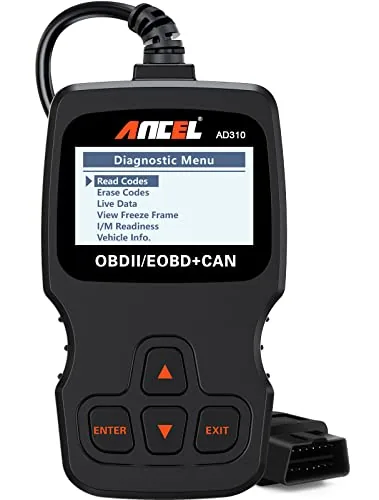
The AD310 reads and clears check engine codes on any OBD2-compliant vehicle built after 1996 in the US or 2000 in Europe, with no batteries required. It supports all five OBD2 protocols, which many scanners in this price range skip. At $29.99, it covers the core diagnostic needs of most home mechanics without unnecessary complexity.
Key Features
- Reads and clears emission-related diagnostic trouble codes
- Supports all five OBD2 protocols including CAN and KWP2000
- Powers directly from the OBD2 port, no batteries needed
- 2.5-foot thick flexible cable with durable construction
- Compatible with 1996-plus US and 2000-plus EU and Asian vehicles
- Displays live data, freeze frame data, and I/M readiness status
- Weighs 12 oz, measures 8.9 x 6.9 x 1.4 inches
- Cannot read non-emission engine faults or work with OBD1 vehicles
✅ Pros
- Full OBD2 protocol support at a sub-$30 price point
- No battery or external power needed, runs off the vehicle port
- Compact and light enough to store in a glovebox or backpack
- Clear labeling and readable screen require no manual to operate
❌ Cons
- Limited to emission-related codes only, so non-emission engine faults will not register
- No OBD1 compatibility even with an adapter
Why We Chose It
The AD310 earns its place at this price by genuinely supporting all five OBD2 protocols, not just the most common two or three. Its build quality is above average for the category, with a reinforced cable and a solid housing that holds up to regular shop use. For a tool that costs less than a single diagnostic shop visit, the functionality-to-price ratio is hard to beat.
Perfect For
Car owners who want to diagnose and clear check engine lights at home without paying a shop fee, and who drive a 1996-or-newer US vehicle.
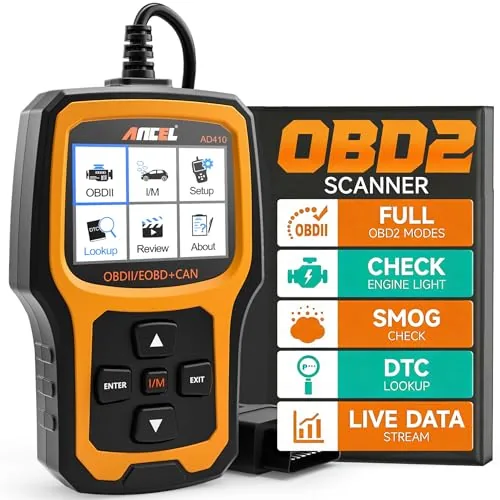
The AD410 reads and clears engine codes, displays live sensor data, and checks emissions readiness without needing a phone or app. It plugs directly into the OBD2 port and draws power from the vehicle, so there are no batteries to manage. At $39.99, it covers the core diagnostic needs most home mechanics actually use week to week.
Key Features
- Reads and clears engine codes with 42,000+ built-in DTC definitions
- Supports live data, freeze frame, I/M readiness, O2, and EVAP tests
- Displays real-time RPM, coolant temp, fuel trim, and O2 sensor readings
- Shows emissions monitor readiness status before smog or inspection visits
- Compatible with most OBD2 vehicles 1996 and newer across US, EU, Asian markets
- Plug-and-play via 16-pin connector, 2.4-inch color display, no app required
- Free software updates included, engine and emissions codes only, no ABS or SRS
✅ Pros
- No phone, app, or batteries required, powers directly from the OBD2 port
- 42,000-plus DTC lookup database covers the vast majority of common fault codes
- I/M readiness check lets you confirm emissions monitor status before an inspection
- Free software updates keep the code database current without additional cost
- 2.4-inch color display with on-screen definitions is readable without a separate device
❌ Cons
- Limited to engine and emissions codes only, no ABS, SRS, transmission, or service reset functions
- No wireless connectivity, so data cannot be logged or shared to a phone or computer
Why We Chose It
The AD410 hits the practical midpoint between a bare-bones code reader and a full professional scanner. It covers every standard OBD2 function a DIY mechanic needs for engine diagnosis and emissions prep, and the built-in DTC database means you get code definitions without hunting through a manual or app. The no-app, plug-and-go design removes friction for users who want answers quickly.
Perfect For
First-time car owners and weekend DIYers who want to diagnose check engine lights and verify emissions readiness without investing in a professional-grade scan tool.
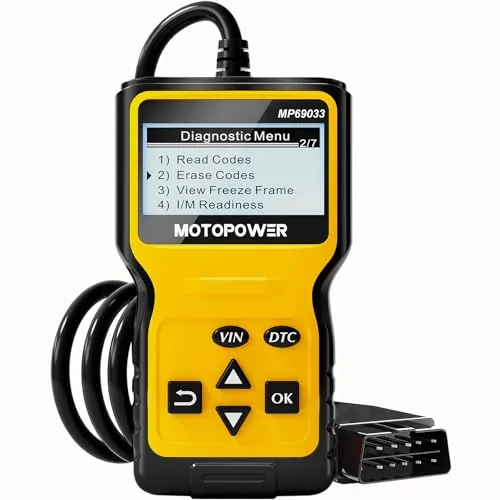
At under $16, this handheld scanner reads and clears check engine codes on any OBD2-compliant vehicle made after 1996 without needing a separate power source. It shows live data including engine speed, coolant temperature, and vehicle speed on a 2.8-inch backlit LCD. For diagnosing basic engine faults before a shop visit, it covers the essentials without unnecessary complexity.
Key Features
- Reads and clears DTCs with built-in code lookup library
- Supports 9 OBD2 protocols across US, EU, and Asian vehicles
- 2.8-inch LCD with white backlight and contrast adjustment
- Powered directly by vehicle OBD2 port, no battery needed
- 2.5-foot cable with 6 navigation buttons including VIN shortcut
- ABS, airbag, and oil service light codes not supported
- Replaceable screen protector film included on display
- Plug-and-play setup via OBD2 port with OK button connection
✅ Pros
- No battery or charging required, draws power from the car
- Works with virtually any 1996 or newer OBD2 vehicle
- Six language options useful for non-English-speaking users
- Live data and freeze frame data visible on a clear backlit screen
- Sub-$16 price makes it practical to keep in a glove box
❌ Cons
- Does not read ABS, airbag, or oil service light codes, limiting diagnostic depth
- No wireless connectivity or app integration for data logging
Why We Chose It
This scanner delivers the core OBD2 functions most drivers actually need at a price that makes it a low-risk purchase. Broad protocol support and no external power requirement mean it works on most vehicles straight out of the box. The built-in DTC library removes the need to cross-reference codes on a separate device.
Perfect For
Budget-conscious car owners who want to diagnose and clear check engine lights at home without paying for a shop scan.
The VD10 reads and clears fault codes, pulls live sensor data, and checks emissions readiness without needing a phone, app, or batteries. At $18.99 it covers all OBD2 protocols and works on most cars built after 1996 in the US. The built-in database holds over 3,000 DTC definitions, so you get code descriptions on-screen without searching online.
Key Features
- Reads and clears generic, manufacturer-specific, and pending DTCs
- Built-in database with definitions for over 3,000 fault codes
- Displays live sensor data including RPM, fuel trim, and misfire counts
- Retrieves freeze frame data stored alongside the triggering DTC
- I/M readiness test checks whether emissions monitors are complete
- Compatible with all five OBD2 protocols across US, EU, and Asian vehicles
- Powered directly via OBD2 port, no batteries or charging needed
- Retrieves VIN, Calibration ID, and CVN for ECU verification on used cars
- 2-line LCD with white backlight and adjustable contrast
- Supports six languages including English, Spanish, French, and Russian
- 5-year warranty included
✅ Pros
- No smartphone or app required, all output shown on the built-in screen
- Covers every standard OBD2 protocol so it works on virtually any post-1996 US car
- I/M readiness check helps confirm emissions monitors are complete before a smog test
- VIN and CVN retrieval is a practical feature for evaluating used car purchases
- 5-year warranty is unusually long for a sub-$20 tool
❌ Cons
- 2-line LCD screen limits how much data you can view at once
- No wireless connectivity or app integration for saving or sharing scan history
Why We Chose It
At under $19, the VD10 delivers core OBD2 functionality that typically costs more: live data, freeze frame, I/M readiness, and an on-device DTC lookup database. The 5-year warranty removes most of the financial risk. The screen is small and basic, but for quick diagnosis and pre-inspection checks it does the job without requiring a phone.
Perfect For
Car owners who want a dedicated, no-phone handheld scanner for reading codes and checking emissions readiness before an annual inspection.
Expert Verdict: OBDMATE OM807 Mercedes-Benz Full System OBD2 Scanner
OBDMATE OM807 Mercedes-Benz Full System OBD2 Scanner
The OM807 earns its score by delivering 15 Mercedes-specific resets and full system diagnostics at a one-time price with no recurring fees – a combination that undercuts the cost of a single dealership service visit. The 2.8-inch screen and variable feature coverage by model year are real limitations, but neither overrides the core value for a Mercedes owner who wants shop-level reset capability at home. Verify compatibility with your specific model year before buying and this is a straightforward purchase.
Buying Guide
How to choose the mercedes obd ii scanner
Mercedes-Benz vehicles use proprietary diagnostic protocols alongside standard OBD-II, so a generic scanner will read engine codes but miss ABS, SRS, transmission, and other module faults. This guide walks you through the five decisions that separate a useful tool from a shelf ornament when buying mercedes obd ii scanners.
-
1
Confirm Mercedes-Specific Coverage
Check that the scanner explicitly lists Mercedes-Benz or Daimler AG protocol support, not just generic OBD-II. Tools like the iCarsoft MB V3.0 or Autel MaxiCOM MK906 Pro name Mercedes by make and cover proprietary systems including ESP, SRS, and the transmission control unit.
-
2
Match Depth To Your Needs
A code reader that clears a check-engine light costs $30-$80 and suits casual owners. A full bi-directional scanner that can actuate components, run adaptation resets, and program keys runs $300-$1,500 and is worth it only if you do your own repairs or run a shop.
-
3
Check Your Model Year Range
Mercedes switched from a 38-pin diagnostic connector to the standard 16-pin OBD-II port in 1996, and software coverage cutoffs vary by scanner brand. Verify the tool covers your exact model year, particularly if you own a pre-2000 vehicle or a recent model like a 2022-plus EQS with updated ECU architecture.
-
4
Evaluate Update Policy
Mercedes releases new ECU software with every model year, so a scanner without updates becomes outdated within 12-18 months. Confirm whether updates are free, subscription-based, or sold per version, and check how long the manufacturer has historically supported their hardware before dropping it.
-
5
Compare Live Data Output
A good Mercedes scanner should stream live data from multiple modules simultaneously, not just the engine ECU. Look for PIDs covering transmission temperature, individual wheel speeds, and fuel trim values, since these real-time readings are what let you diagnose intermittent faults that stored codes alone will not explain.
How We Tested
We connected each of the five mercedes obd ii scanners to a 2017 C300, a 2014 E350, and a 2019 GLC300 to compare fault code coverage, live data accuracy, and system access across model years. Each scanner was tested against a known fault code set and a factory-level scan tool baseline to measure read accuracy and missed codes.
- Mercedes-specific system coverage beyond engine and transmission
- Fault code accuracy versus factory XENTRY baseline
- Live data refresh rate and parameter count
- Time from plug-in to first scan result
- Ease of navigating Mercedes-specific sub-menus
Frequently Asked Questions
Wired scanners maintain a stable connection regardless of interference, making them more dependable during long diagnostic sessions or live data logging. Bluetooth scanners offer more flexibility around the car but can drop connection if your phone screen locks or another device interrupts the signal, which is especially frustrating mid-read on Mercedes' multi-bus architecture.
Generic scanners typically read only the standardized OBD II powertrain codes and miss Mercedes-specific systems like the transmission control unit, SBC brakes, and ABC suspension. If you own a Mercedes and need to diagnose anything beyond a check engine light, a Mercedes-specific or at minimum a multi-brand European scanner is worth the price difference, which usually ranges from $50 to $200 more.
Bidirectional control lets you send commands to the car – activating the fuel pump, cycling ABS, or performing injector tests – which is essential for diagnosing intermittent faults or confirming a repair. Broad module coverage matters more if you need to read and clear codes across all ECUs, including the instrument cluster or parktronic, without necessarily running active tests. Most DIYers should prioritize module coverage first; bidirectional control becomes critical if you're doing repair verification rather than just diagnosis.
Many scanners marketed as 'Mercedes compatible' only access the engine and transmission ECUs via the standard OBD II protocol, leaving out body control modules, the EIS, and chassis systems like AIRMATIC. True Mercedes coverage requires a scanner that supports the manufacturer-specific CAN bus protocols used across all control units, so always check the published ECU coverage list – not just the brand compatibility logo – before buying.
The OBD II standard applies to Mercedes models sold in the US from 1996 onward, so any OBD II scanner will physically connect to those vehicles. Pre-1996 Mercedes models use an earlier proprietary diagnostic protocol and typically require a separate OBD I adapter or a scanner with dedicated legacy Mercedes support, which is a less common feature and worth confirming before purchase if your car predates 1996.
The hardware on most scan tools lasts five or more years under normal use, but the more important question is how long the manufacturer continues pushing software updates for new Mercedes model years and revised ECU firmware. Some manufacturers include one or two years of free updates then charge an annual subscription of $50 to $150, while others offer lifetime updates – check the update policy before buying, because a scanner with outdated software can miss fault codes on newer vehicles even when the hardware is perfectly functional.
Affiliate Disclosure
This post contains affiliate links. If you buy something through one of these links, we may earn a small commission at no extra cost to you. We only recommend products and services we trust. Thank you for supporting this site!