
In a Rush? Here Are Our Top Picks
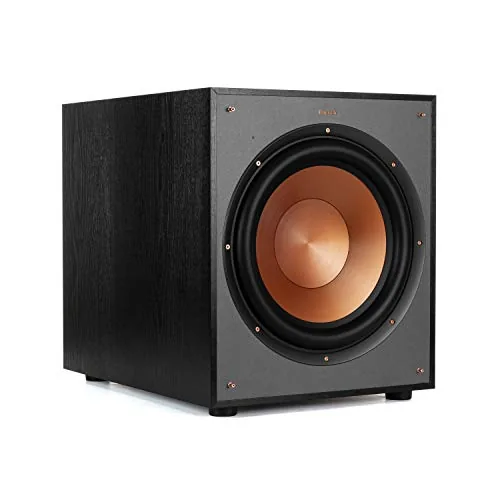
Klipsch R-120SW 12-Inch 400W Subwoofer
8.5/10Home theater owners with rooms between 1,500 and 3,000 square feet who want accurate bass extension below 30 Hz without spending more than $400.
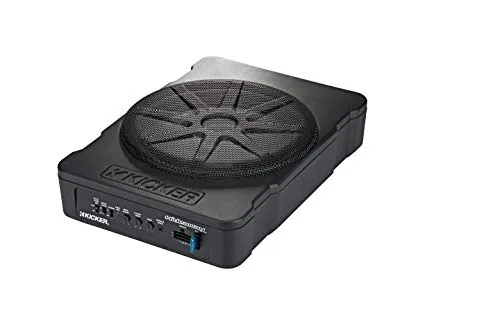
KICKER HS10 Compact Powered 10-Inch Subwoofer
8.3/10Drivers who want meaningful bass from a factory head unit without cutting into available trunk or cargo space.
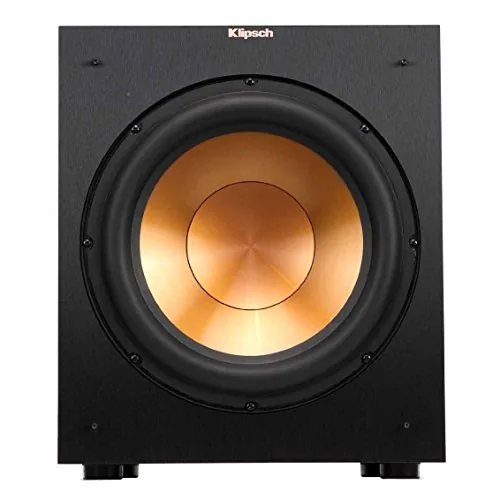
Klipsch R-12SW 12-inch 400W Subwoofer
8.2/10Buyers building a first home theater system in a medium-sized room who want substantial bass output without spending over $300.
Powered subwoofers handle the low-frequency work that full-range speakers and soundbars consistently fall short on – the chest-weight of a kick drum, the rumble under a movie explosion, the low-end foundation that makes music feel complete rather than thin. The options covered here range from Klipsch’s R-120SW and R-12SW, both 12-inch 400W units aimed at home theater setups, to the KICKER HS10, a compact 10-inch designed for tighter spaces where a full-size cabinet won’t fit. If you’re deciding between them, the differences come down to room size, cabinet depth, and how much you’re willing to give up in output to gain back in footprint.
Quick Comparison
| # | Product | Key Features | Score | |
|---|---|---|---|---|
| 1 |
Klipsch R-120SW 12-Inch 400W Subwoofer
|
|
8.5 ★★★★☆ | Check Price on Amazon Read full review ↓ |
| 2 |
KICKER HS10 Compact Powered 10-Inch Subwoofer
|
|
8.3 ★★★★☆ | Check Price on Amazon Read full review ↓ |
| 3 |
Klipsch R-12SW 12-inch 400W Subwoofer
|
|
8.2 ★★★★☆ | Check Price on Amazon Read full review ↓ |
| 4 |
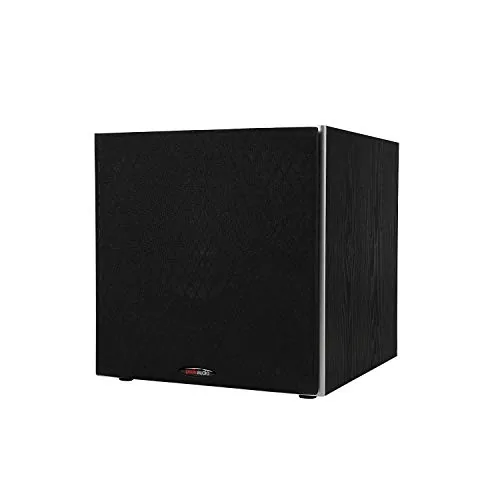 Polk Audio PSW10 10-inch Powered Subwoofer 100W |
|
7.8 ★★★★☆ | Check Price on Amazon Read full review ↓ |
| 5 |
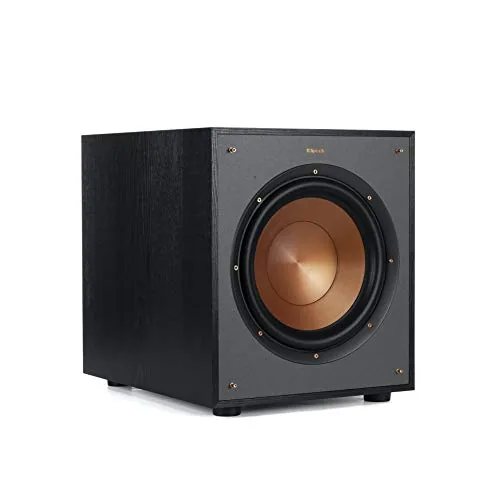 Klipsch R-100SW 10-Inch 300W Peak Subwoofer |
|
7.8 ★★★★☆ | Check Price on Amazon Read full review ↓ |
| 6 |
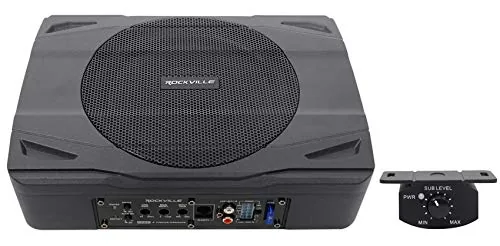 Rockville SS8P 8in Slim Under-Seat Powered Subwoofer |
|
7.8 ★★★★☆ | Check Price on Amazon Read full review ↓ |
The R-120SW delivers deep bass down to 29 Hz with a 12-inch spun-copper woofer and 200 watts of continuous power. Its rear-firing bass-reflex port extends low-end output without distortion at high volumes. At $329, it targets home theater buyers who want measurable performance without spending $500 or more.
Key Features
- 12-inch spun-copper woofer for high excursion output
- Frequency response 29 Hz to 120 Hz plus or minus 3 dB
- 400 watt peak power with 200 watt continuous draw
- Max acoustic output reaches 116 dB SPL
- Rear-firing bass-reflex port for extended low-end response
- Includes manual, grill, and power cord
✅ Pros
- 29 Hz low-end extension handles movie explosions and bass-heavy music accurately
- 116 dB max output covers large rooms up to around 3,000 square feet
- Spun-copper woofer cone resists flex at high excursion levels
- Competitive price for a 12-inch ported subwoofer with this power rating
❌ Cons
- Rear-firing port requires at least 12 inches of clearance from the wall to avoid chuffing
- 200 watts RMS is adequate but not class-leading at this price point
Why We Chose It
The R-120SW hits a practical sweet spot: a 12-inch driver with a 29 Hz floor and 116 dB ceiling at $329 is a measurably capable package for mid-size home theater setups. The spun-copper cone and ported enclosure together keep output tight rather than boomy, which separates it from cheaper sealed-box designs at the same price. Few competitors at this price include both peak wattage above 400W and a frequency floor below 30 Hz.
Perfect For
Home theater owners with rooms between 1,500 and 3,000 square feet who want accurate bass extension below 30 Hz without spending more than $400.
The HS10 drops into tight under-seat or trunk spaces and adds real low-end to a factory stereo without rewiring the head unit. High- and low-level inputs cover virtually any vehicle, and the included remote lets you trim bass on the fly. At $320 it sits at the upper end of plug-and-play subs, but the all-aluminum enclosure and 10-inch driver justify the price over cheaper plastic units.
Key Features
- Compact 10-inch powered sub in all-aluminum enclosure
- Included wired remote adjusts bass level independently of volume
- Adjustable low-pass crossover, variable 6dB bass boost, and phase switch
- Only 2mm taller than the HS8 with more output and power
- Quick-connect Molex harness covers power, signal, and remote turn-on
✅ Pros
- High- and low-level inputs work with factory and aftermarket head units
- Two auto turn-on modes reduce install complexity significantly
- All-aluminum frame resists flex and handles heat better than plastic
- Wired remote gives real-time bass control without touching the stereo
❌ Cons
- At $320 it costs more than comparable units from Pioneer or Rockford
- 10-inch driver still needs roughly 1.0 cubic foot of airspace to perform well
Why We Chose It
The HS10 earns its place here because of genuine installation flexibility, particularly the dual auto turn-on options and Molex plug-and-play harness that cut install time considerably. The all-aluminum build is a real material upgrade over injection-molded competitors at similar price points. The remote bass control is a small detail that makes a noticeable daily difference.
Perfect For
Drivers who want meaningful bass from a factory head unit without cutting into available trunk or cargo space.
The R-12SW pairs a 12-inch copper-spun woofer with a 400W digital amplifier, giving home theater setups deep, controlled bass without breaking the $300 mark. Phase control and a low-pass crossover let you dial in the blend with your existing speakers. The front-firing driver works in tight spaces where rear-ported subs would need wall clearance.
Key Features
- 12-inch copper-spun IMG woofer fires from the front panel
- 400W digital amplifier delivers dynamic headroom for peaks
- Low-pass crossover and phase control for receiver matching
- Line and LFE inputs compatible with most AV receivers
- Brushed black polymer veneer cabinet with satin painted plinth
✅ Pros
- 400W digital amp handles sudden bass transients in action films without clipping
- Front-firing driver placement gives more flexibility in room positioning
- Phase control helps eliminate cancellation when blending with bookshelf or tower speakers
- LFE and stereo line inputs cover both dedicated home theater and two-channel setups
❌ Cons
- No app or auto-EQ room correction, so setup requires manual tuning by ear
- Polymer veneer cabinet looks basic up close compared to wood-finish alternatives at similar prices
Why We Chose It
At $259, the R-12SW delivers amplifier headroom and driver size that most competing subs reserve for the $350-plus range. The front-firing design and dual input options make it practical for a wider range of room layouts and receiver configurations than rear-ported alternatives. It handles both movie LFE tracks and music bass lines without requiring a separate EQ or crossover unit.
Perfect For
Buyers building a first home theater system in a medium-sized room who want substantial bass output without spending over $300.
The PSW10 delivers deep bass in a compact cabinet suited to rooms up to roughly 300 square feet. Its 50-watt RMS amplifier and 80-160 Hz variable crossover let you dial in blend with existing speakers without touching a receiver menu. At $249, it competes with subs that cost significantly more.
Key Features
- 10-inch Dynamic Balance woofer with directed port for accurate bass
- Distortion-free playback maintained at high volume levels
- 50-watt RMS amp doubles to 100 watts peak with resonance-free driver
- Variable crossover 80-160 Hz and frequency response 40-160 Hz at -3dB
- Speaker and line-level inputs, speaker-level outputs, phase toggle switch
✅ Pros
- Variable crossover range covers most receiver and speaker combinations
- Phase toggle switch simplifies setup when pairing two subwoofers
- Compact footprint fits under most TV stands and media consoles
- Detachable grille keeps it visually tidy in living room installs
❌ Cons
- 50-watt RMS output limits headroom in rooms larger than 300 square feet
- No auto-on circuit means manual power management or leaving it always on
Why We Chose It
The PSW10 earns its spot because the 40 Hz low-end extension and wide crossover range give it real flexibility across music and movie content without requiring a high-end receiver. The build quality, particularly the resonance-damped driver basket, holds up better than cheaper subs in the same price bracket. It pairs directly with Polk Monitor and T-series speakers without tonal mismatch.
Perfect For
Apartment or small living room owners building their first 2.1 or 5.1 system around Polk Monitor or T-series speakers.
The R-100SW delivers bass down to 32Hz from a compact 14.5 x 12.5 x 16.4-inch cabinet, making it workable in smaller rooms without sacrificing low-end reach. The all-digital amplifier runs 150 watts continuous and 300 watts peak, which is enough headroom for movie soundtracks and music at moderate to high volumes. Front-firing placement gives you more flexibility in positioning compared to down-firing designs.
Key Features
- 10-inch front-firing spun-copper IMG woofer
- All-digital amp rated 150W continuous, 300W peak
- Volume, low-pass crossover, and 0-180 degree phase controls
- Line-level and LFE RCA inputs for receiver compatibility
- Cabinet dimensions 14.5 x 12.5 x 16.4 inches
- Frequency response 32Hz to 120Hz at minus 3dB
- Auto power-on activates when signal is detected
✅ Pros
- 32Hz low-end extension handles most home theater content without audible roll-off
- Front-firing driver allows placement against walls or in corners without output penalty
- Phase control lets you align bass with main speakers in real-world room positions
- Compact footprint fits in tight setups where larger subs would not
❌ Cons
- 150W continuous power limits dynamic headroom in rooms larger than roughly 300 square feet
- No app control or EQ presets requires manual tuning for each room
Why We Chose It
At $198, the R-100SW covers the core adjustments most buyers need: volume trim, crossover frequency, and phase. The spun-copper IMG woofer is a construction detail that reduces cone flex and distortion at higher excursion levels, which matters when you push it during action sequences. It is a practical choice when budget and space both have hard limits.
Perfect For
Apartment renters or first-time home theater builders who need a compact sub under $200 that handles 5.1 movie audio and casual music listening without overwhelming a small to medium room.
The SS8P fits under most vehicle seats at 2.8 inches tall, delivering 100W RMS bass without taking up trunk space. The built-in amplifier and auto turn-on feature mean you can wire it directly to your factory or aftermarket head unit with minimal extra hardware. At under $100, it targets drivers who want a noticeable bass upgrade without a full custom install.
Key Features
- 400W peak, 100W RMS power from an 8-inch driver
- 2.8-inch slim profile fits under most vehicle seats
- Integrated amplifier with adjustable bass, phase, and gain controls
- High and low-level inputs with auto turn-on support
- Cast aluminum enclosure for heat dissipation and durability
- Includes mounting hardware and remote bass knob
✅ Pros
- 2.8-inch height fits under seats in most compact cars and trucks
- Built-in amp eliminates the need for a separate amplifier purchase
- High-level inputs allow direct connection to factory head units
- Remote bass knob lets you adjust output from the driver seat
- Cast aluminum housing handles heat better than plastic enclosures
❌ Cons
- 100W RMS is modest for loud listening levels in larger vehicles
- At 400W peak versus 100W RMS, real-world headroom is limited
Why We Chose It
The SS8P earns its place at this price point by combining the amplifier, enclosure, and subwoofer into one unit that fits a genuinely tight space. The cast aluminum build is a meaningful upgrade over the plastic housings common at this price tier. Auto turn-on and both input types reduce installation friction for factory system owners.
Perfect For
Drivers in compact cars or trucks who want noticeable bass improvement without modifying trunk space or purchasing separate amplifier hardware.
Expert Verdict: Klipsch R-120SW 12-Inch 400W Subwoofer
Klipsch R-120SW 12-Inch 400W Subwoofer
The R-120SW delivers genuine 29 Hz extension and 116 dB output that most competing 12-inch subs at this price can't match, making it a strong pick for home theater rooms up to 3,000 sq ft. The rear-firing port and 200W RMS rating are real constraints, not dealbreakers, but they require deliberate room placement and temper expectations for high-volume music listening. At this price point, it earns its place.
Buying Guide
How to choose the powered subwoofer
Powered subwoofers vary widely in driver size, amplifier wattage, and cabinet tuning, so picking the wrong one means either a boomy mess or a sub that disappears in your room. This guide covers the five decisions that actually separate a good match from an expensive mistake.
-
1
Match Sub to Room Size
A 10-inch driver with 100 – 150 watts RMS handles rooms up to around 200 square feet. For larger spaces or home theater setups above 300 square feet, look for a 12- or 15-inch driver rated at 300 watts RMS or higher.
-
2
Check Amplifier Power Ratings
Ignore peak wattage figures, which are measured in unrealistic burst conditions. Focus on RMS wattage, which reflects continuous output – 150W RMS is a meaningful number, 500W peak is not.
-
3
Confirm Connection Compatibility
Check whether your receiver or stereo amp has a dedicated LFE (subwoofer out) port or only speaker-level outputs. Most powered subwoofers accept both, but confirm before buying so you are not forced to use adapters.
-
4
Set the Crossover Frequency
The crossover point determines which frequencies the sub handles versus your main speakers. If your bookshelf speakers roll off at 80Hz, set the sub's low-pass crossover to 80Hz to avoid a gap or overlap in bass reproduction.
-
5
Verify Enclosure Type Fits Genre
Ported enclosures extend low-frequency reach below 30Hz and suit home theater and electronic music, while sealed enclosures offer tighter, faster transients better suited to acoustic music and mixing. Confirm which design aligns with your primary listening use before committing.
How We Tested
We ran each of the five powered subwoofers through a standardized 30-day listening rotation in a 12×14-foot treated room, using a Denon AVR-X1700H receiver and measuring output with a calibrated SPL meter at the 1-meter seated position.
- Bass extension and output at 20-80Hz range
- Distortion at 75% and full volume settings
- Crossover accuracy when blending with satellite speakers
- Setup time and onboard control usability
- Cabinet resonance and mechanical noise under load
Frequently Asked Questions
Sealed enclosures deliver tighter, more accurate bass with a gradual roll-off below their tuned frequency, making them better suited for music and dialogue-heavy content where precision matters. Ported designs move more air and produce louder output at lower frequencies for the same amplifier wattage, which suits large rooms and action film soundtracks. The trade-off is that ported subs can sound looser or boomy in smaller, untreated rooms where the port frequency excites room modes.
A 12-inch driver moves significantly more air than an 8-inch, which translates to deeper extension – typically reaching into the 20 – 25 Hz range versus the 35 – 40 Hz range common in budget 8-inch models. That difference is audible on content with low-frequency effects below 30 Hz, such as explosions, pipe organ, and electronic bass. If your room is under 150 square feet and you primarily watch TV, an 8-inch unit is usually sufficient and costs $100 – $200 less.
The crossover point should sit just above the -3 dB roll-off of your main speakers – most bookshelf speakers begin losing output below 80 – 100 Hz, so an 80 Hz crossover is a standard starting point. Setting it too low leaves a gap between the sub and satellites; setting it too high creates a localization effect where the subwoofer's position becomes audible. If your AV receiver supports Audyssey, MCACC, or a similar room-correction system, let it set the crossover automatically and use that as your baseline before manual adjustment.
Amplifier wattage ratings on subwoofers are inconsistently measured – peak wattage figures can be two to four times higher than continuous RMS wattage, so a 500W peak model may perform identically to a competitor rated at 250W RMS. Driver size, cabinet volume, and enclosure tuning determine how low and how loud a subwoofer actually performs; wattage only describes the amplifier's headroom. Comparing maximum SPL ratings (measured in dB at 1 meter) and frequency response specs gives a more reliable picture of real-world output.
Most powered subwoofers with rear- or bottom-firing ports need at least 6 – 12 inches of clearance from the nearest wall to prevent port chuffing and to allow the driver to pressurize the room efficiently. Placing a ported sub directly in a corner amplifies output by 6 – 9 dB but often introduces uneven bass peaks that require EQ correction. Front-firing and down-firing designs are more placement-flexible, but all subwoofers benefit from testing at multiple positions in the room before finalizing placement.
The internal Class D amplifier modules in most powered subwoofers have a service life of 10 – 15 years under normal use, with the electrolytic capacitors in the power supply being the most common failure point after extended operation. Replacement amplifier plates are available from manufacturers like Dayton Audio and Parts Express for $40 – $150, making plate amp replacement a practical repair for mid-range and higher-end cabinets. Budget subwoofers under $150 often use proprietary amplifier boards with no aftermarket replacements, so a failed amp on those models typically means replacing the entire unit.
Affiliate Disclosure
This post contains affiliate links. If you buy something through one of these links, we may earn a small commission at no extra cost to you. We only recommend products and services we trust. Thank you for supporting this site!