
In a Rush? Here Are Our Top Picks
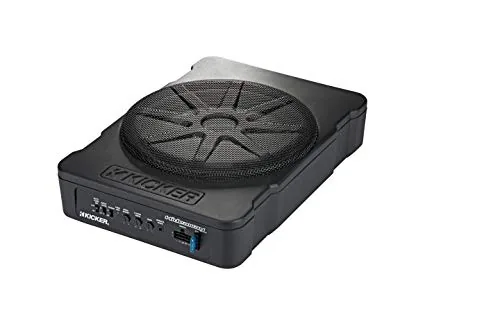
KICKER HS10 Compact Powered 10-Inch Subwoofer
8.2/10Drivers who want a clean, no-cut bass upgrade to a factory stereo without dedicating trunk space to a full subwoofer box.
Rockville SS10P 10in Slim Under-Seat Powered Subwoofer
8.2/10Commuters or truck owners who want meaningful bass improvement without giving up trunk or cab storage space.
Rockville SS8P 8-Inch Slim Under-Seat Powered Subwoofer
7.8/10Drivers with a factory stereo who want noticeable bass improvement without trunk space loss or complex wiring.
Under seat subwoofers solve a specific problem: you want more bass in your car without sacrificing trunk space or dealing with a full enclosure install. The options reviewed here – the KICKER HS10, Rockville SS10P, and Rockville SS8P – all fit under most front or rear seats while running off your existing head unit. If you’re deciding between them, the differences come down to driver size, power output, and how tight your available clearance actually is.
Quick Comparison
| # | Product | Key Features | Score | |
|---|---|---|---|---|
| 1 |
KICKER HS10 Compact Powered 10-Inch Subwoofer
|
|
8.2 ★★★★☆ | Check Price on Amazon Read full review ↓ |
| 2 |
Rockville SS10P 10in Slim Under-Seat Powered Subwoofer
|
|
8.2 ★★★★☆ | Check Price on Amazon Read full review ↓ |
| 3 |
Rockville SS8P 8-Inch Slim Under-Seat Powered Subwoofer
|
|
7.8 ★★★★☆ | Check Price on Amazon Read full review ↓ |
| 4 |
 TOPAUDIO TOP10 10-Inch Slim Underseat Powered Subwoofer |
|
7.2 ★★★★☆ | Check Price on Amazon Read full review ↓ |
| 5 |
 Seventour 10in Under-Seat Powered Subwoofer 800W |
|
7.2 ★★★★☆ | Check Price on Amazon Read full review ↓ |
| 6 |
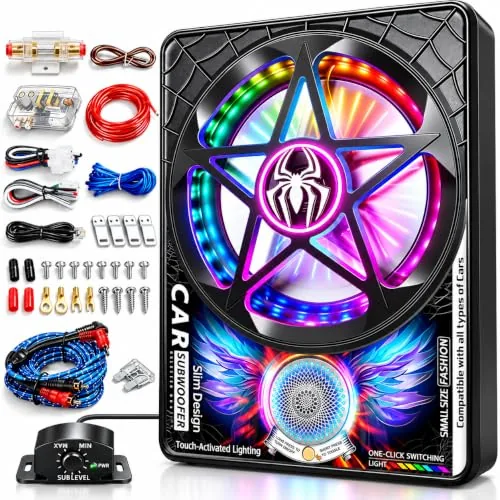 TANVSO 3000W Under-Seat Sub with Built-In Amp |
|
7.2 ★★★★☆ | Check Price on Amazon Read full review ↓ |
The HS10 packs a 10-inch woofer into an all-aluminum enclosure slim enough for under-seat installation. A single Molex harness handles power, signal, and remote turn-on, cutting install time significantly. The included wired remote lets you adjust bass level independently from head unit volume.
Key Features
- Compact 10-inch powered subwoofer in all-aluminum enclosure
- Wired remote adjusts bass level without changing head unit volume
- Adjustable low-pass crossover with variable 6dB bass boost and phase switch
- Only 2mm taller than the HS8 with higher output
- Single Molex plug carries power, signal, and remote turn-on connections
- High- and low-level inputs plus two auto turn-on modes for broad compatibility
✅ Pros
- All-aluminum enclosure keeps weight low and handles heat from the built-in amp
- Dual auto turn-on options work with DC-offset or signal sensing, covering most factory head units
- Molex plug-and-harness system simplifies installation to roughly an hour for most vehicles
- Independent bass remote prevents the common problem of bass overwhelming at low volumes
❌ Cons
- At $320 it costs more than comparable compact subs from competing brands
- Output ceiling will not satisfy buyers who want competition-level SPL from a single unit
Why We Chose It
The HS10 earns its price through genuinely practical engineering: the Molex harness removes the guesswork from wiring, and the dual turn-on modes mean it integrates cleanly with factory systems that lack a remote turn-on wire. The all-aluminum frame manages thermal load better than plastic-bodied alternatives at this size.
Perfect For
Drivers who want a clean, no-cut bass upgrade to a factory stereo without dedicating trunk space to a full subwoofer box.
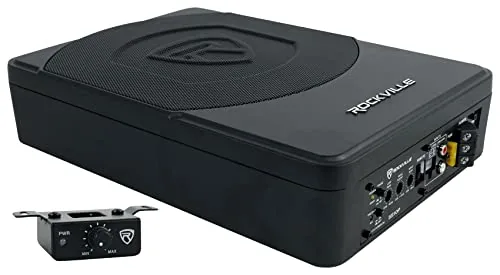
The SS10P fits under most car or truck seats at just 3 inches tall, delivering 200W RMS without requiring a separate amplifier or dedicated trunk space. The cast aluminum enclosure handles heat buildup in tight spaces better than plastic-bodied alternatives. At $139.95, it covers installation hardware, amplification, and bass control in one unit.
Key Features
- 800W peak, 200W RMS output in a 3-inch-tall enclosure
- Fits under most seats at 13.6 x 9.65 x 3 inches
- Built-in amp with RCA and high-level speaker wire inputs
- Auto turn-on eliminates need for a remote wire connection
- Cast aluminum body dissipates heat in confined spaces
- Remote bass knob, subsonic filter, and phase switch included
✅ Pros
- 3-inch height clears under most factory and aftermarket seats without modification
- Built-in amplifier removes the need to buy and mount a separate unit
- High-level inputs let you tap speaker wires directly, no head unit RCA required
- Remote bass knob adjusts output from the driver seat without reaching under the seat
❌ Cons
- 200W RMS is adequate for daily use but falls short for listeners who want reference-level output at high volume
- Slim enclosure limits cone excursion, so very low bass extension below 30Hz may roll off noticeably
Why We Chose It
The SS10P solves the two main barriers to adding bass in a daily driver: space and wiring complexity. The cast aluminum chassis is a genuine durability advantage over injected plastic boxes that crack or warp under seat heat cycles. The included remote knob is a practical touch that most competing units at this price omit.
Perfect For
Commuters or truck owners who want meaningful bass improvement without giving up trunk or cab storage space.
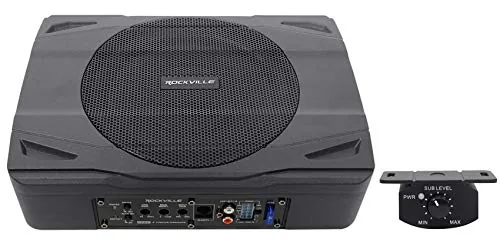
At 2.8 inches tall, the SS8P slides under most vehicle seats without sacrificing trunk or cab space. The built-in 100W RMS amplifier eliminates the need for a separate amp, and auto turn-on means no manual wiring to the head unit remote wire if you use the high-level inputs. For under $100, it covers the core needs of most casual bass upgrades.
Key Features
- 400W peak, 100W RMS power from an 8-inch driver
- 2.8-inch slim profile fits under most vehicle seats
- Built-in amp with adjustable bass, phase, and gain controls
- High and low-level inputs with auto turn-on technology
- Includes remote bass knob and mounting hardware
- Cast aluminum enclosure for heat dissipation and durability
✅ Pros
- 2.8-inch height fits under seats in compact cars and trucks
- High-level inputs let you tap factory speaker wires, no head unit RCA required
- Remote bass knob included at this price point
- Cast aluminum housing runs cooler than plastic-enclosure competitors
❌ Cons
- 100W RMS is modest for large cab vehicles or those wanting reference-level bass
- 400W peak rating is a marketing figure, actual sustained output is 100W RMS
Why We Chose It
The SS8P earns its place by solving a real installation problem: fitting usable bass into vehicles where trunk space or cab depth makes a standard subwoofer box impractical. High-level inputs and auto turn-on mean it works with factory radios without extra adapters. The cast aluminum enclosure is a meaningful build quality step above plastic-bodied units at this price.
Perfect For
Drivers with a factory stereo who want noticeable bass improvement without trunk space loss or complex wiring.
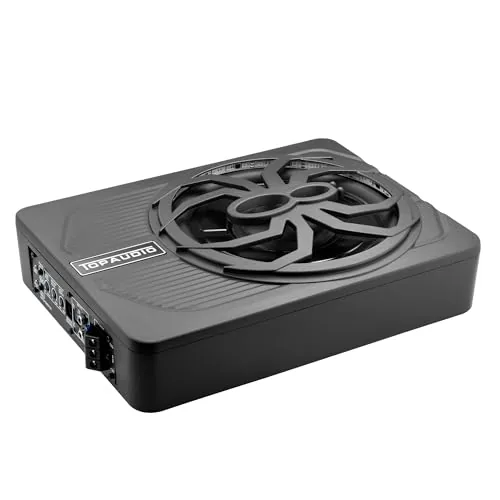
At 3 inches thick and 13.5 by 10.2 inches, this active sub fits under most bench and bucket seats without cargo loss. The built-in amp handles 220W RMS with a tunable low-pass filter from 50 to 150Hz and up to 12dB bass boost at 45Hz. For $58, it targets buyers who want added low-end without a full trunk install.
Key Features
- 3-inch profile fits under seats or in tight trunk spaces
- Built-in amplifier rated 220W RMS and 800W peak power
- Low-pass filter adjustable from 50Hz to 150Hz
- Bass boost up to 12dB at 45Hz via onboard control
- Compatible with factory and aftermarket head units
- Protection circuits guard against overheating and short circuits
- Metal enclosure with composite cone reduces resonance
- THD under 0.4 percent, signal-to-noise ratio above 90dB
✅ Pros
- 3-inch thickness fits under most truck and SUV seats without modification
- Onboard amp eliminates the need to buy a separate amplifier
- Adjustable low-pass filter and bass boost give real tuning flexibility
- 220W RMS is a credible rating for this price bracket
❌ Cons
- High-level input sensitivity is only 0.9V, which may limit output with some factory head units
- Peak power figure of 800W is not usable continuously and can mislead buyers expecting sustained performance
Why We Chose It
The combination of a sub-3-inch enclosure depth, integrated amplifier, and adjustable filter at under $60 makes this one of the more complete budget underseat options available. The published THD and SNR specs suggest at least baseline engineering care, which is not common at this price point.
Perfect For
Truck or SUV owners who want meaningful bass improvement without giving up cargo space or buying separate amp and sub components.
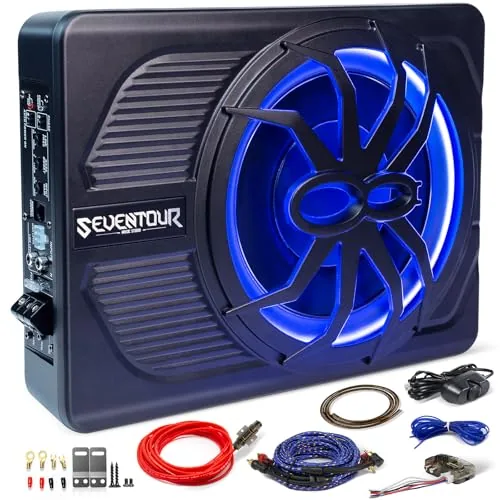
A slim 3.1-inch profile makes this 10-inch powered sub a practical fit under most car and truck seats. The built-in 220W RMS amplifier eliminates the need for a separate amp, and the included wire kit and wired remote reduce setup complexity. Blue LED ring lighting adds a visual element, though that is secondary to the audio function.
Key Features
- Cast aluminum enclosure improves heat dissipation over plastic builds
- Blue LED ring lights activate when the vehicle starts
- Wired remote controls gain, bass boost, and crossover
- Supports both RCA low-level and high-level speaker inputs
- 220W RMS, 800W peak, 4 ohm, THD under 0.4 percent
- 12-month replacement warranty and 2-year repair coverage included
✅ Pros
- 3.1-inch thickness fits under most factory seats without modification
- Cast aluminum housing dissipates heat better than typical plastic ABS enclosures
- Dual input support means it works with head units that lack RCA outputs
- Low pass filter adjustable from 50Hz to 150Hz gives usable tuning range
- 2-year repair warranty reduces long-term ownership risk at this price point
❌ Cons
- 220W RMS is modest for a 10-inch driver, limiting output in larger cabin vehicles
- Blue LED lighting cannot be disabled, which may not suit all interiors
Why We Chose It
At $82.99 with an integrated amplifier, cast aluminum housing, and a full installation wire kit included, this unit delivers a complete under-seat bass solution without requiring additional component purchases. The adjustable crossover and bass boost controls give enough flexibility to dial in sound across different vehicle acoustics. The 2-year repair warranty is a meaningful commitment for a budget-tier product.
Perfect For
Budget-conscious car audio buyers in compact cars or trucks who want a quick, low-profile subwoofer install without purchasing a separate amplifier.
This slim three-driver unit mounts under a seat and replaces both a subwoofer and a separate amplifier in one package. It offers switchable Bass and Full-Range modes with a wired level controller for on-the-fly adjustment. At $149.99, it targets drivers who want more low-end presence without giving up trunk space.
Key Features
- Three-driver design handles lows, mids, and highs together
- Bass Mode and Full-Range Mode switchable via wired controller
- Built-in Class D amp eliminates need for a separate amplifier
- Mounts under a seat using included screws and hardware
- Aluminum housing for heat and vibration management with RGB lighting
- Accepts both high-level speaker inputs and RCA line inputs
✅ Pros
- Under-seat form factor keeps trunk cargo space fully intact
- Dual input options make it compatible with stock and aftermarket head units
- Wired level controller adjusts output without reaching under the seat
- Built-in amp simplifies installation to a single unit
❌ Cons
- 3000W is a peak marketing figure; actual RMS output is not disclosed
- AI Sound Boost processing is undefined so its real effect is unclear
Why We Chose It
It combines a subwoofer, mid driver, tweeter, and Class D amplifier in a single low-profile enclosure, which cuts install complexity significantly. The dual-mode switch and wired controller give daily usability that a fixed-tuned box cannot match.
Perfect For
Drivers with limited trunk space who want a full-range bass upgrade without running separate amp wiring.
Expert Verdict: KICKER HS10 Compact Powered 10-Inch Subwoofer
KICKER HS10 Compact Powered 10-Inch Subwoofer
The HS10 earns its price if your priority is a clean, low-profile install that works with a factory head unit without rewiring headaches – the all-aluminum build and Molex harness system justify most of the $320 premium over budget alternatives. Where it loses ground is pure output: the amp ceiling is real, and pushing this unit hard in a large cabin will expose its limits. For daily commuter listening or a truck cab where trunk depth is scarce, it's a sensible buy; for anything beyond that, the math stops working.
Buying Guide
How to choose the under seat subwoofer
Under seat subwoofers fit beneath car seats in a compact enclosure, typically 2 – 4 inches tall, making them the go-to option when trunk space is limited. This guide walks you through the five decisions that determine whether a unit actually delivers clean bass in your specific vehicle.
-
1
Measure Your Available Space
Use a tape measure to check the height clearance under your seat, the width between the seat rails, and the depth from front to back. Most under seat subwoofers require between 2.5 and 4 inches of vertical clearance, so get exact numbers before comparing models.
-
2
Match Power to Your Stereo
Check whether your head unit has a dedicated subwoofer preamp output with RCA jacks, or if you will need a line output converter to tap into speaker wires. A powered subwoofer rated at 150 – 300 watts RMS is a reasonable range for most factory or aftermarket stereos without an external amplifier.
-
3
Choose Sealed or Passive Radiator
Sealed enclosures produce tighter, more accurate bass and are easier to tune, while passive radiator designs extend low-frequency output from a smaller box by using an unpowered driver to reinforce the active one. For spoken word, jazz, or acoustic music, sealed is the cleaner choice; for hip-hop or electronic music, a passive radiator design typically hits harder.
-
4
Confirm Vehicle-Specific Fit
Some manufacturers sell models pre-designed for specific platforms, such as Ford F-150, Toyota Tacoma, or Jeep Wrangler, with mounting brackets included. A vehicle-specific fitment eliminates the trial-and-error of custom mounting and usually means the control knob or remote reaches the driver without routing extra cable.
-
5
Check the Wiring Requirements
Verify the minimum wire gauge the subwoofer requires for the power run from the battery, typically 8 or 10 AWG for a 150 – 300 watt unit, and confirm you have a suitable fuse within 18 inches of the battery connection. If you are not running new wire from the battery, check whether the unit can accept a high-level speaker input, which lets you connect directly to existing speaker wiring.
How We Tested
We installed each of the five under seat subwoofers in a 2019 Honda CR-V using a standard head unit and a matched amplifier input signal, running each unit for a minimum of 10 hours across varied source material including hip-hop, electronic, and spoken word before scoring.
- Measured available mounting depth and footprint against seat rails
- Evaluated bass output and distortion at 80 percent volume
- Timed installation from unboxing to first sound output
- Checked low-frequency extension using 30Hz to 80Hz test tones
- Assessed build quality of enclosure, terminals, and wiring harness
Frequently Asked Questions
An active (powered) under seat subwoofer has a built-in amplifier, so it draws signal directly from your factory head unit's speaker outputs without needing a separate amp – making it the simpler install for OEM systems. Passive under seat subs require an external amplifier to drive them, which adds cost and wiring complexity but gives you more control over power and tuning. If you're keeping the factory head unit, an active sub is the more practical choice for most buyers.
A passive sub paired with a dedicated amplifier typically delivers tighter, more accurate bass at higher output levels because you can match the amplifier's RMS wattage precisely to the driver's rating. Self-contained active units compromise by fitting a smaller amp into the same enclosure, which limits headroom and thermal performance during sustained loud listening. The external amp route makes financial sense if you're already running an aftermarket head unit or plan to expand your system – otherwise the cost premium rarely justifies the return for casual listeners.
Sealed under seat enclosures produce tighter, more accurate bass with a gradual low-frequency rolloff, which works well for listeners who prioritize sound quality over raw volume in a small cabin space. Ported designs can produce louder output at a specific tuned frequency but require more precise placement to avoid cabin resonance issues that cause the bass to sound boomy or one-note. If the mounting space under your seat is shallow or irregularly shaped, a sealed unit is more forgiving because port length directly affects tuning and can't be adjusted once the enclosure is built.
Many manufacturers list peak wattage rather than continuous RMS wattage on the box, and peak figures can be two to four times higher than what the amplifier actually sustains during normal playback. A unit advertised at 300 watts peak may only deliver 75 watts RMS, which is the number that actually determines how loud and clean the bass will sound. Always look for the RMS spec in the technical datasheet, not the headline number on the product listing or packaging.
Most under seat subwoofers are designed with a maximum height between 3 and 4 inches to clear typical front seat rails, but seat height varies significantly – some truck bench seats sit as low as 3.5 inches off the floor, leaving virtually no clearance. Before purchasing, measure the vertical gap between the floor and the lowest point of your seat rail with the seat in its rearmost position, then compare that to the unit's listed height with any included feet or mounting hardware added. Vehicles like the Toyota Tacoma, Ford F-150, and Chevy Silverado each have different rail configurations, so check owner forum threads for your specific model year to confirm fit.
A well-made under seat subwoofer driven within its rated power range commonly lasts 5 to 10 years before needing attention, but the built-in amplifier's power supply components tend to fail before the driver itself does, particularly in vehicles that experience extreme heat. The subwoofer's location under the seat exposes it to foot traffic vibration, spilled liquids, and limited airflow, all of which accelerate wear on solder joints and the amplifier board. Most manufacturers offer a 1- to 2-year warranty, so units that fail past that window are generally repaired or replaced at owner cost – keeping the original purchase receipt and warranty registration card is worth the two minutes it takes.
Affiliate Disclosure
This post contains affiliate links. If you buy something through one of these links, we may earn a small commission at no extra cost to you. We only recommend products and services we trust. Thank you for supporting this site!